
The Secret World of Arrietty (2010)
Story overview
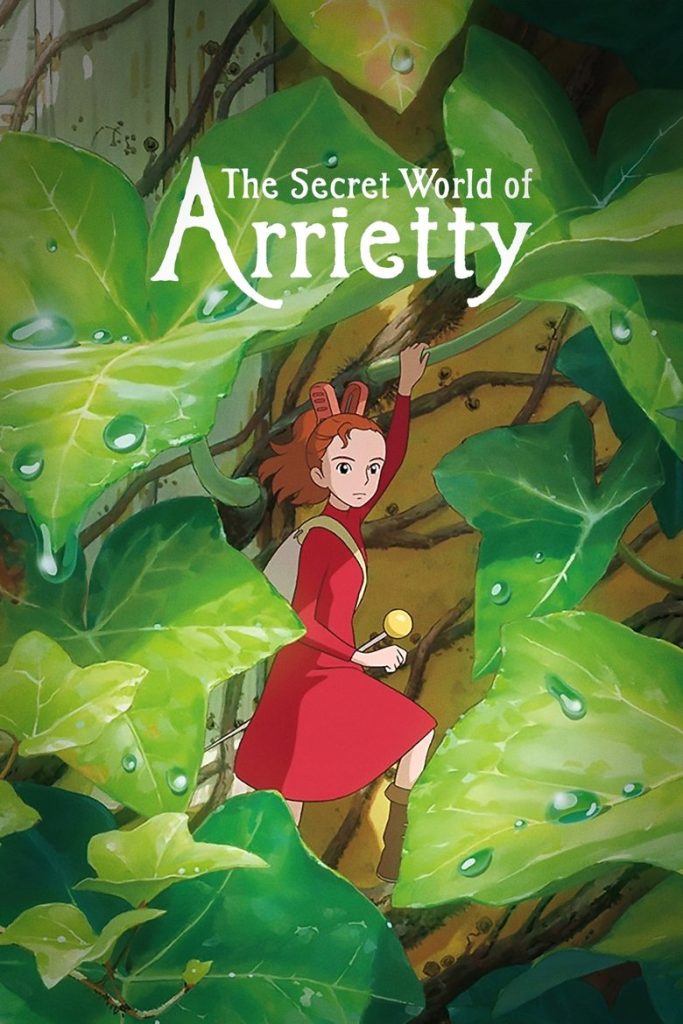
The Secret World of Arrietty is a gentle animated fantasy about tiny people called Borrowers who live secretly in human homes. Fourteen-year-old Arrietty and her family maintain their hidden existence by carefully taking small items from the humans around them. Their peaceful life faces challenges when a human boy discovers Arrietty, creating a delicate connection between their two worlds. The film explores themes of friendship, family bonds, and finding courage in unfamiliar situations.
Parent Guide
A gentle, beautifully animated fantasy with positive themes of friendship and understanding, suitable for most children with minimal concerns.
Content breakdown
Some mild peril when characters face discovery or potential danger, including scenes with a cat that might startle very young viewers. No physical violence occurs.
A few tense moments when the tiny characters are in potentially dangerous situations, but nothing graphic or prolonged. Some children might find the idea of being tiny and vulnerable unsettling.
No offensive language or harsh words are used in the film.
No sexual content, romance, or nudity appears in the film.
No depiction of alcohol, drugs, tobacco, or substance use.
Emotional moments related to family bonds and potential separation, but handled gently. The overall mood is contemplative rather than intensely emotional.
Parent tips
This G-rated Studio Ghibli film offers a beautiful, gentle viewing experience suitable for most children. The animation is visually stunning with detailed miniature worlds that will captivate young viewers. While there are moments of mild tension when the Borrowers face discovery, the overall tone remains calm and thoughtful rather than action-packed.
Parents should know the film moves at a deliberate pace that emphasizes atmosphere and character relationships over fast-paced plot. Some children might find the slower sections less engaging, but the film's themes of empathy and understanding different perspectives provide excellent conversation starters. The cultural elements reflect its Japanese origins while remaining accessible to international audiences.
Parent chat guide
After the film, explore questions about friendship across differences and what it means to respect others' ways of living. The film naturally leads to conversations about empathy, family loyalty, and facing fears. For younger children, you might focus on the imaginative aspects of tiny people living in walls, while older children can discuss the more nuanced themes of coexistence and change.
Parent follow-up questions
- What was your favorite tiny thing the Borrowers used?
- How would you feel if you were as small as Arrietty?
- What makes a good friend in the movie?
- Which character was the kindest?
- What would you borrow if you were a Borrower?
- Why do you think the Borrowers have to stay hidden?
- How does Arrietty show bravery in the story?
- What did the human boy learn from meeting Arrietty?
- How do the characters help each other even though they're different?
- What does the movie teach us about understanding others?
- What challenges do both Arrietty and the human boy face in their friendship?
- How does the film show the importance of family traditions?
- What does the story suggest about fear of the unknown?
- How do the characters balance curiosity with caution?
- What might the Borrowers represent in our own world?
- How does the film explore themes of coexistence between different groups?
- What commentary might the story offer about human consumption and resource use?
- How do cultural differences between Japanese and Western storytelling appear in the film?
- What does the relationship between Arrietty and her parents reveal about growing up?
- How does the film handle the tension between safety and exploration?
🎭 Story Kernel
At its heart, 'The Secret World of Arrietty' is a meditation on the quiet dignity of existence under constant threat. It's not really about the Borrowers' physical survival—though that's the plot's engine—but about their psychological survival: maintaining identity, purpose, and hope when your entire world could be erased by a single careless human act. Arrietty's first borrowing is a coming-of-age ritual, but also a declaration of existence. Shawn's illness makes him an observer of fragility, creating a bridge between two worlds where both parties are, in different ways, vanishing. The real tension isn't whether they'll be discovered, but whether any meaningful connection can survive in a world that demands isolation for safety.
🎬 Visual Aesthetics
Studio Ghibli crafts a world where scale defines everything. The camera often adopts a low-angle perspective, not just to show the Borrowers' view, but to make domestic spaces feel like cathedral interiors—a floorboard crack becomes a canyon, a dripping faucet a waterfall. The color palette is lush but controlled: vibrant greens and garden hues for the natural world Arrietty navigates, contrasted with the warm, wooden tones of the Borrowers' home—a sanctuary of amber light. Action is deliberate and tactile; every movement of a pin or sugar cube carries weight. The absence of dramatic music during borrowing sequences amplifies the tension, making ambient sounds—creaking floors, rustling leaves—feel monumental.
🔍 Details & Easter Eggs
💡 Behind the Scenes
The film is adapted from Mary Norton's 'The Borrowers,' but director Hiromasa Yonebayashi (making his directorial debut) relocated the setting from England to a fictionalized version of Koganei, Tokyo, where Studio Ghibli is actually located. Arrietty's Japanese voice actor, Mirai Shida, was only 13 during recording, matching the character's age. Composer Cécile Corbel learned to play the harp specifically for the soundtrack, wanting authentic Celtic influences despite the Japanese setting. The garden was meticulously researched using real plants from the Kanto region, with animators studying insect perspectives to get the scale exactly right.
Where to watch
Choose region:
- HBO Max
- HBO Max Amazon Channel
- Amazon Video
- Apple TV
- Google Play Movies
- YouTube
- Fandango At Home
Trailer
Trailer playback is unavailable in your region.