
The Sting (1973)
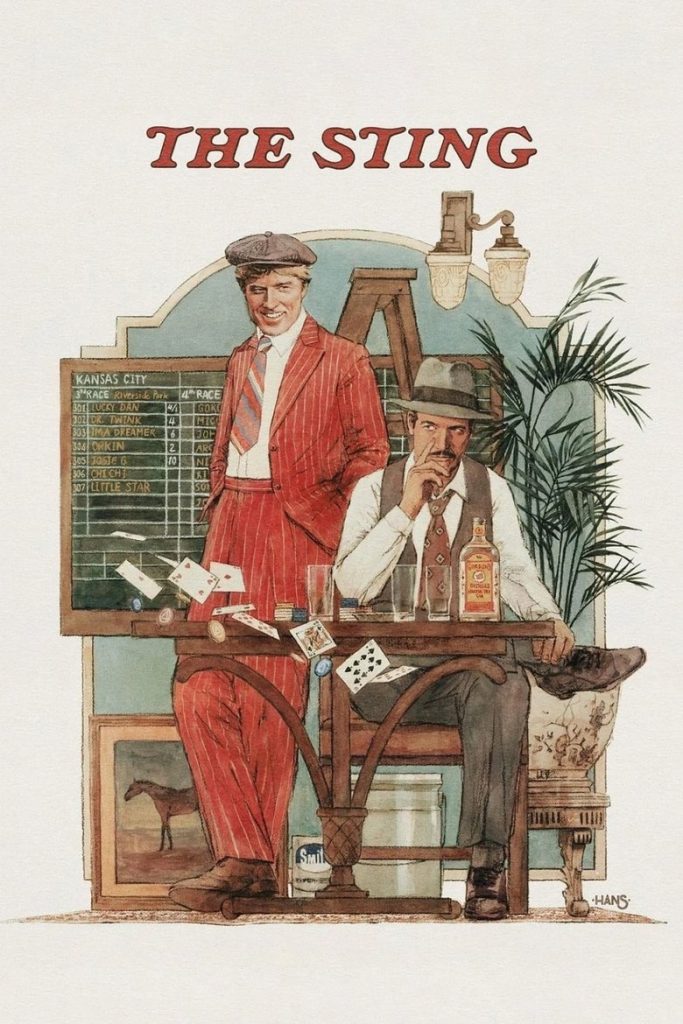
Story overview
The Sting is a classic 1970s comedy-crime film about two con artists who team up to execute an elaborate scheme against a dangerous mobster. Set in the 1930s, it follows their clever planning and deception as they seek revenge for a friend's murder. The movie focuses on the intricate details of their con rather than violent action, with a lighthearted tone despite its criminal subject matter.
Parent Guide
A clever crime comedy with mild violence and period-typical smoking, best for older children who can understand the complex plot.
Content breakdown
Some gun violence including a murder that motivates the plot, but not graphic. Characters face peril during cons but without intense physical violence.
Mild tension during cons and criminal confrontations. The murder occurs off-screen and isn't shown graphically.
Occasional mild profanity and period-typical slang. Nothing strong or frequent.
No sexual content or nudity. Some mild flirtation in keeping with 1930s style.
Frequent smoking throughout, reflecting the 1930s setting. Some social drinking in bars and clubs.
Moderate tension during cons and revenge plot, balanced by comedic elements. Characters face betrayal and danger but maintain lighthearted tone.
Parent tips
The Sting features gambling, criminal activity, and some mild violence including a murder that motivates the plot. While the film has a PG rating and maintains a generally comedic tone, it presents crime as clever and entertaining rather than showing serious consequences. Parents should be aware that characters smoke frequently throughout the film, reflecting the 1930s setting, and there's some mild language.
The movie's complex plot involving multiple layers of deception might be confusing for younger viewers, but older children and teens can appreciate the clever storytelling. The film doesn't glorify violence but does show characters engaging in illegal activities as part of their revenge scheme.
Parent chat guide
During viewing, you might pause to explain the complex con schemes if children seem confused. Point out how the film uses humor to balance the criminal elements.
After watching, discuss the difference between entertainment and real-life consequences of criminal behavior. Talk about why revenge might seem satisfying in stories but often has negative outcomes in reality.
Parent follow-up questions
- What was your favorite part of the movie?
- Did you understand what the characters were trying to do?
- How did the music make you feel during the movie?
- What colors or clothes did you notice in the movie?
- Was there anything that confused you?
- Why do you think the characters wanted to trick the mobster?
- What made the con artists' plan clever?
- How did the movie show the difference between good guys and bad guys?
- What did you learn about how people lived in the 1930s?
- Would you want to be friends with any of the characters?
- What skills did the con artists use to execute their plan?
- How did the film balance comedy with more serious themes?
- What messages does the movie send about revenge and justice?
- How does the historical setting affect the story?
- What might be different if this story happened today?
- How does the film portray criminal activity as entertainment?
- What ethical questions does the revenge plot raise?
- How does the film's structure with multiple cons affect the storytelling?
- What commentary might the film be making about capitalism or the American Dream?
- How does the 1970s perspective shape this story about the 1930s?
🎭 Story Kernel
At its core, 'The Sting' explores the artistry of deception as a form of revenge and self-reinvention. Henry Gondorff and Johnny Hooker aren't just after money—they're orchestrating an elaborate performance to restore dignity after their friend's murder. The film suggests that in a corrupt world, the con becomes a legitimate craft, a way to rebalance scales when justice fails. Each character plays multiple roles, blurring lines between actor and audience, until the final reveal questions who was truly in control. The elaborate scheme becomes their theater, with Doyle Lonnegan as the unwitting patron whose hubris makes him the perfect mark.
🎬 Visual Aesthetics
Director George Roy Hill employs a nostalgic sepia-toned palette that evokes both 1930s Chicago and vintage photographs, creating a storybook quality that softens the grift's harsh realities. The split-screen sequences during complex cons function like comic book panels, breaking down intricate maneuvers into digestible visual beats. Transition cards styled after Saturday Evening Post illustrations add playful artifice, reminding viewers they're watching an elaborate performance. The camera often lingers on Paul Newman's and Robert Redford's faces during silent moments, capturing unspoken calculations and the thrill of the game.
🔍 Details & Easter Eggs
💡 Behind the Scenes
Paul Newman and Robert Redford's chemistry was so natural that director George Roy Hill encouraged improvisation, particularly in their casual banter scenes. The ragtime score by Marvin Hamlisch, adapting Scott Joplin's music, was controversial—Joplin's style was 20 years out of date for the 1936 setting, but Hill insisted it created the perfect nostalgic tone. The elaborate con sequences required meticulous storyboarding, with the production hiring actual magicians as consultants. Robert Shaw developed Doyle Lonnegan's Irish-American accent by studying Chicago gangsters of the era, though he was English.
Where to watch
Choose region:
- Amazon Video
- Apple TV
- Google Play Movies
- YouTube
- Fandango At Home
- Spectrum On Demand
Trailer
Trailer playback is unavailable in your region.