
The Two Popes (2019)
Story overview
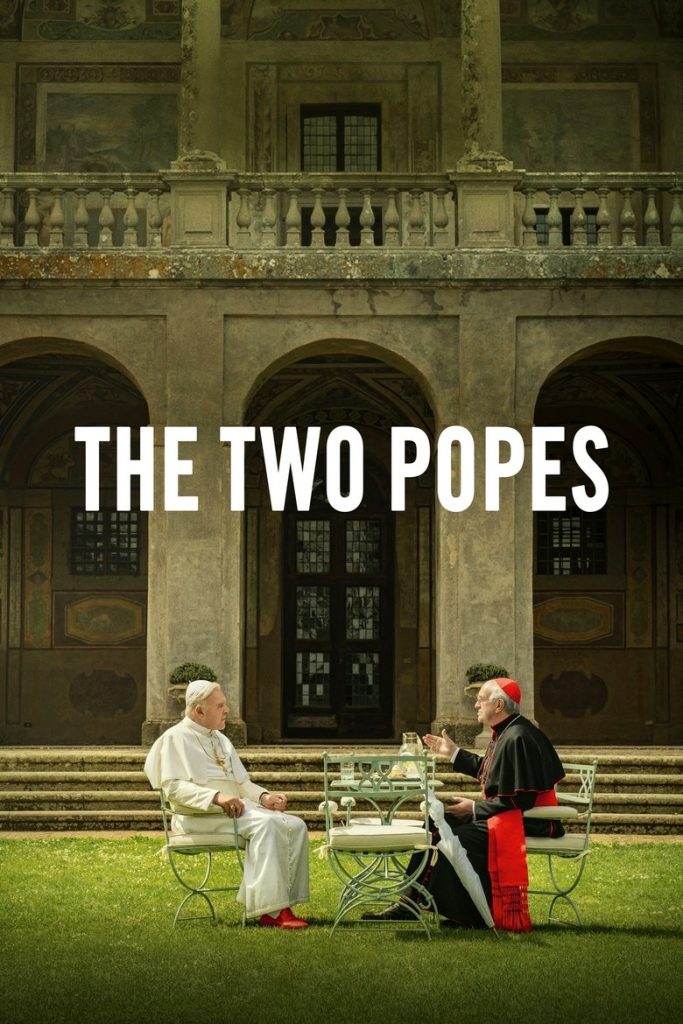
The Two Popes is a 2019 historical drama that imagines private conversations between Pope Benedict XVI and Cardinal Jorge Bergoglio, who would later become Pope Francis. The film explores their differing perspectives on faith, tradition, and the future of the Catholic Church. Through dialogue and flashbacks, it examines personal struggles, institutional challenges, and the human side of religious leadership.
Parent Guide
A thoughtful dialogue-driven film about religious leadership and personal conviction, suitable for mature children and teenagers.
Content breakdown
No violence or physical peril depicted.
No frightening or disturbing imagery.
No offensive language.
No sexual content or nudity.
No substance use depicted.
Some emotional discussions about faith, doubt, and institutional responsibility.
Parent tips
This film is suitable for mature children and teenagers who can engage with thoughtful dialogue about religion, leadership, and personal conviction. The PG-13 rating reflects its complex themes rather than objectionable content. Parents may want to watch with younger viewers to discuss the historical and religious context, as the film assumes some familiarity with Catholicism and recent papal history.
Parent chat guide
Parent follow-up questions
- Did you see any people talking in the movie?
- What colors did you notice in the places they visited?
- How did the music make you feel?
- What were the two main characters talking about most of the time?
- How were their clothes different from regular clothes?
- What places did they visit in the movie?
- What differences did you notice between the two popes' approaches to leadership?
- How did the flashbacks help explain the characters' backgrounds?
- What challenges were they discussing about the Church?
- How does the film explore the tension between institutional tradition and necessary change?
- What did you think about the portrayal of personal doubt in religious leadership?
- How effective was the film in humanizing figures who are often seen only symbolically?
🎭 Story Kernel
At its core, 'The Two Popes' explores the tension between institutional tradition and personal faith in the modern world. It's not really about Benedict vs. Francis - it's about two approaches to Catholicism wrestling within every believer. Benedict represents the fortress: faith as doctrine, structure, and preservation. Francis embodies the field hospital: faith as mercy, adaptation, and service. Their debates about gay marriage, poverty, and church scandals become a profound meditation on whether institutions can evolve without losing their souls. The real drama isn't about who becomes pope, but whether either man can reconcile their private doubts with their public roles.
🎬 Visual Aesthetics
Director Fernando Meirelles uses visual language to mirror the theological divide. The Vatican is shot with cold, sterile precision - marble halls feel like museums, with static compositions and a blue-gray palette emphasizing institutional rigidity. Contrast this with Argentina: handheld cameras, warm golden light, and crowded frames bursting with life. Notice how Benedict is often framed alone in vast spaces, visually isolated by his office, while Francis is constantly surrounded by people. The most telling visual choice: when they finally connect, the camera relaxes, the color warms, and they share the frame as equals in the Sistine Chapel's human-scale side rooms rather than its overwhelming main hall.
🔍 Details & Easter Eggs
💡 Behind the Scenes
Anthony Hopkins and Jonathan Pryce spent weeks studying their real-life counterparts' mannerisms, with Hopkins mastering Benedict's slight German accent and Pryce learning Spanish to perform Francis's dialogue authentically. The Vatican scenes were filmed at Rome's Cinecittà Studios since the actual Vatican doesn't permit filming, requiring meticulous recreation of the Sistine Chapel's frescoes. Director Meirelles insisted on using natural light whenever possible, leading to specific shooting schedules to capture the exact quality of Roman light that filters through Vatican windows. The script evolved significantly after screenwriter Anthony McCarten met with Vatican insiders who revealed previously private details about the papal transition.
Where to watch
Choose region:
- Netflix
- Netflix Standard with Ads
Trailer
Trailer playback is unavailable in your region.