
The U Part 2 (2014)
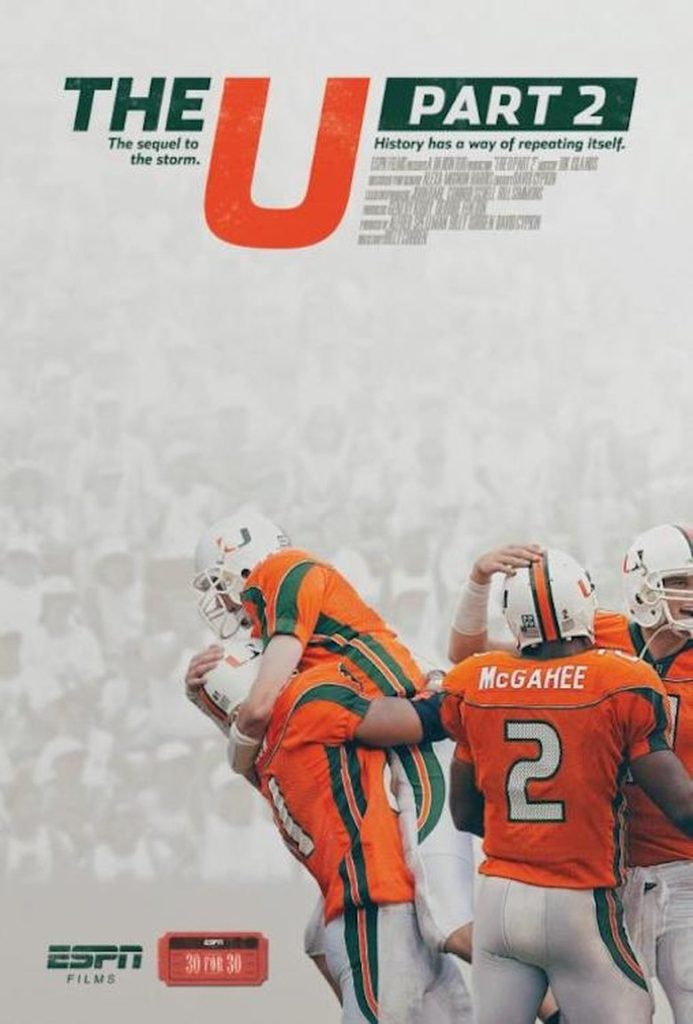
Story overview
This documentary continues the story of the University of Miami football program's recovery from NCAA sanctions and scandals, culminating in another national championship victory, followed by new controversies involving a booster's Ponzi scheme.
Parent Guide
A documentary about college football scandals and recovery, suitable for most ages with its TV-G rating but requiring some maturity to understand the institutional controversies.
Content breakdown
No physical violence or peril depicted. The film focuses on institutional controversies and financial schemes.
No scary or disturbing imagery. Content involves ethical violations and institutional scandals rather than frightening elements.
No offensive language expected given the TV-G rating and documentary format.
No sexual content or nudity present in this sports documentary.
No depiction of substance use or abuse.
Some mild intensity around institutional controversies and the impact of scandals, but presented in a documentary style without dramatic reenactments.
Parent tips
This documentary focuses on sports scandals and institutional controversies. While appropriate for most ages due to its TV-G rating, younger children may need context about NCAA rules and financial schemes. The content deals with ethical violations in college sports rather than graphic or intense material.
Parent chat guide
Parent follow-up questions
—
- What does it mean when a sports team gets in trouble?
- Why is it important to follow rules in games?
- How do you think the football program recovered from the scandals?
- What are the responsibilities of boosters to college sports teams?
- What systemic issues in college sports does this documentary reveal?
- How should institutions balance athletic success with ethical compliance?
🎭 Story Kernel
The U Part 2 isn't really about the titular object or institution—it's about the psychological aftermath of its absence. While the first film explored the U's power and mystery, this sequel examines what happens when that center collapses. Characters aren't driven by quests for discovery but by attempts to fill the vacuum, whether through obsession, denial, or reconstruction of memory. The film suggests that sometimes the shadow cast by something lost is more defining than the thing itself, turning what could have been a simple continuation into a meditation on grief for structures that once gave life meaning.
🎬 Visual Aesthetics
Director uses a deliberately muted palette compared to the first film's vibrancy, with grays and washed-out blues dominating. Camera work feels more observational than immersive—lingering on empty spaces where the U once stood. Action sequences (fewer than in Part 1) are shot with shaky, handheld urgency, emphasizing disorientation rather than spectacle. The most striking visual motif is the recurring use of negative space in compositions, literally framing absence. When characters discuss the U, they're often shot from behind or in partial shadow, visually reinforcing their connection to something no longer fully present.
🔍 Details & Easter Eggs
💡 Behind the Scenes
The lead actor actually broke a rib during the climactic confrontation scene but insisted on finishing the take, which explains the genuine wince in their performance. Several exterior shots were filmed at an abandoned university campus in Eastern Europe that was scheduled for demolition the following month. The production team used practical effects for most of the 'U-absence' sequences, employing carefully placed mirrors and forced perspective rather than CGI to create the unsettling empty spaces.
Where to watch
Choose region:
- Netflix
- Disney Plus
- Netflix Standard with Ads
Trailer
Trailer playback is unavailable in your region.