The Wild Robot (2024)
Story overview
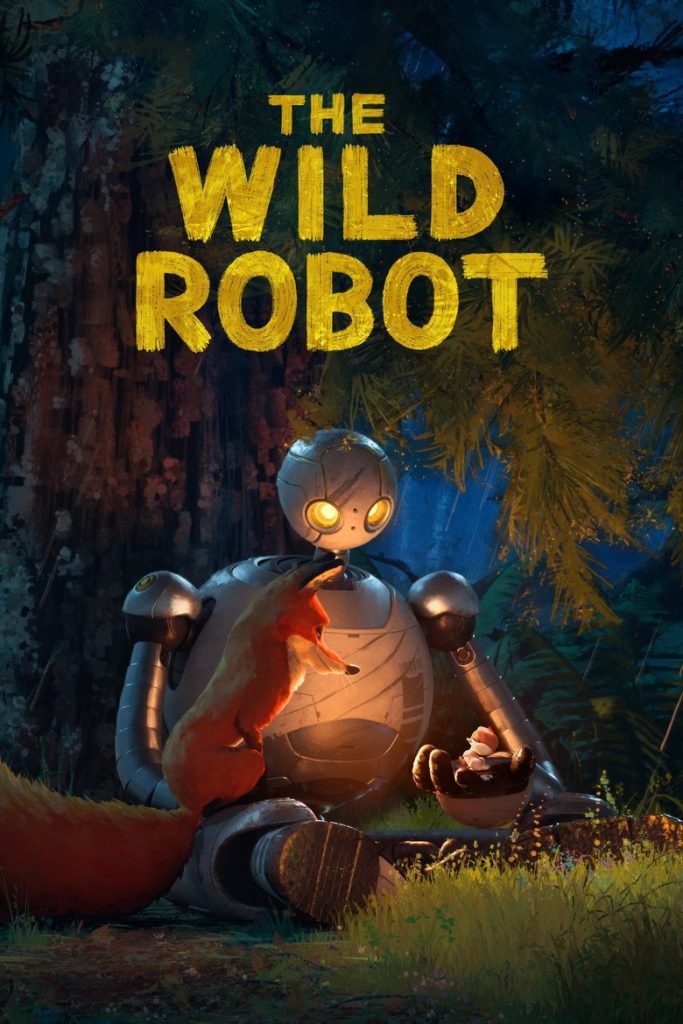
The Wild Robot follows Roz, an intelligent robot who finds herself stranded on a remote island after a shipwreck. To adapt to this unfamiliar wilderness, Roz forms unexpected connections with the island's animal inhabitants. The story centers on Roz's journey of survival and her developing relationship with an orphaned baby goose, exploring themes of adaptation, community, and caregiving in a natural setting.
Parent Guide
A gentle animated adventure exploring themes of adaptation, community, and caregiving with mild peril elements suitable for most children.
Content breakdown
Contains scenes of a shipwreck and wilderness survival situations that create mild tension but no graphic violence.
Some scenes of isolation and adaptation challenges in an unfamiliar environment might be momentarily unsettling for very young viewers.
No offensive language present in this family-friendly film.
No sexual content or nudity in this animated feature.
No depiction of substance use.
Contains themes of separation, adaptation, and caregiving that create gentle emotional moments without being overwhelming.
Parent tips
This animated adventure offers gentle themes of found family and environmental adaptation that will resonate with most children. The PG rating suggests some mild elements that might require parental guidance, such as the initial peril of the shipwreck and the robot's adjustment to wilderness survival. The film's exploration of belonging and nurturing relationships provides positive messages about empathy and cooperation that parents can reinforce.
Parent chat guide
Parent follow-up questions
- What animals did you see on the island?
- How did Roz help the baby goose?
- What was your favorite part of the movie?
- How do you think Roz felt when she first arrived on the island?
- What did Roz learn from the animals?
- How did Roz adapt to living in the wilderness?
- What challenges did Roz face on the island?
- How did the animals and Roz learn to work together?
- What does it mean to care for someone who is different from you?
- What would you do if you found yourself in a new place like Roz did?
- What does Roz's journey teach us about adaptation and survival?
- How does the movie show the importance of community and cooperation?
- What might the story be saying about technology and nature coexisting?
- How did Roz's relationship with the animals change throughout the film?
- What personal qualities helped Roz succeed in her new environment?
- How does the film explore themes of identity and belonging through Roz's experience?
- What commentary might the story offer about artificial intelligence and natural ecosystems?
- How does the concept of 'found family' develop throughout the narrative?
- What does Roz's care for the orphaned goose reveal about nurturing and responsibility?
- How might this story relate to real-world situations of adaptation and community building?
🎭 Story Kernel
The Wild Robot is a profound exploration of the intersection between artificial intelligence and biological instinct, centering on Roz, a ROZZUM unit 7134 stranded on an uninhabited island. At its core, the film is an examination of motherhood and the transformative power of choice over programming. Roz’s journey from a task-oriented servant to a nurturing protector of an orphaned gosling, Brightbill, illustrates that identity is not fixed by one's origin. The narrative posits that kindness is a vital survival skill, challenging the 'survival of the fittest' mentality. By overriding her core directives to meet the emotional needs of her environment, Roz demonstrates that the capacity to care is the ultimate form of intelligence. The film ultimately expresses that we are more than what we were built to be, emphasizing the beauty of found family and communal sacrifice.
🎬 Visual Aesthetics
Director Chris Sanders employs a breathtaking 'painterly' aesthetic that breaks away from the hyper-realistic trend of modern CGI. The film’s visual language is a tribute to classical animation and impressionist art, featuring visible brushstrokes and a soft, organic texture that makes every frame look like a living illustration. This style serves a thematic purpose: the lush, hand-crafted backgrounds of the island contrast with Roz’s initial metallic rigidity, visually documenting her integration into the natural world. The cinematography uses light and color to mirror Roz’s emotional awakening, shifting from the cold, clinical blues of her activation to the warm, golden hues of the forest. This synthesis of high-tech rendering and traditional artistry creates a timeless atmosphere that emphasizes the harmony between technology and nature, echoing the works of Hayao Miyazaki and Disney’s Bambi.
🔍 Details & Easter Eggs
💡 Behind the Scenes
The film is based on the 2016 best-selling novel by Peter Brown. Director Chris Sanders, who previously directed 'Lilo & Stitch' and 'How to Train Your Dragon,' aimed to create a visual style that felt 'handmade' to honor the source material's illustrations. Lupita Nyong’o, the voice of Roz, meticulously developed the character's vocal arc, starting with a robotic, staccato delivery reminiscent of digital assistants and gradually infusing more warmth and rhythmic variation as Roz became more 'human.' The production team at DreamWorks utilized new rendering technologies to achieve the film's signature painterly look, which required blending 3D geometry with 2D-inspired textures.
Where to watch
Choose region:
- Netflix
- Netflix Standard with Ads
- Amazon Video
- Apple TV
- Google Play Movies
- YouTube
- Fandango At Home
- FlixFling
Trailer
Trailer playback is unavailable in your region.