
The Witcher Bestiary Season 1, Part 2 (2020)
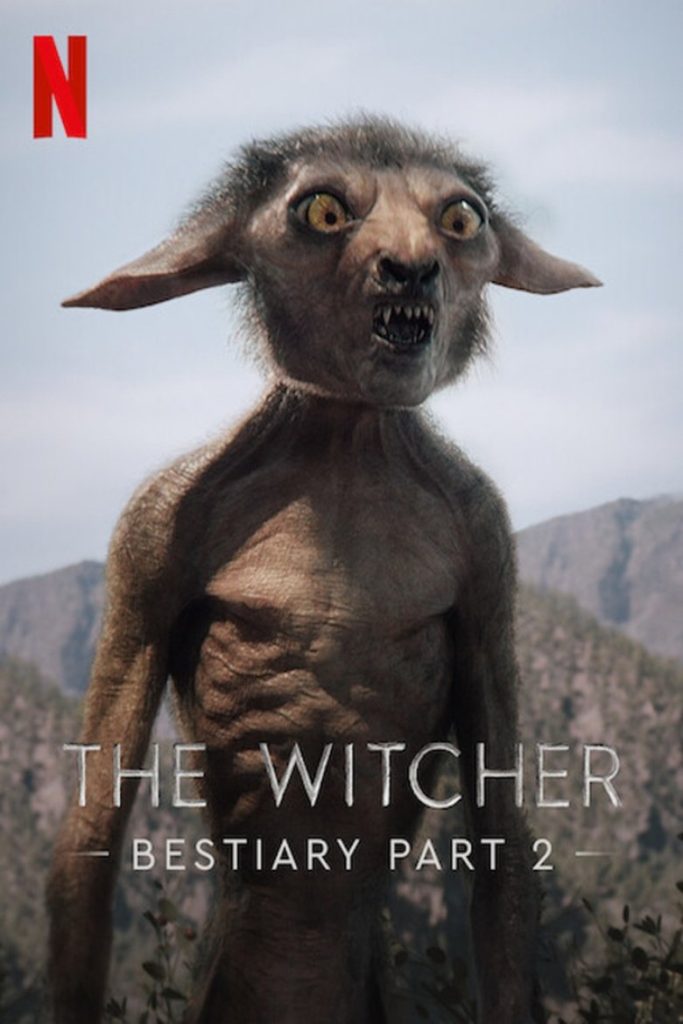
Story overview
This documentary explores the mythical creatures from 'The Witcher' universe, focusing on beasts like basilisks and dragons. It examines their folklore origins and how monster hunter Geralt encounters them in the series. The content is presented as an educational look at fantasy mythology rather than a narrative story.
Parent Guide
Educational documentary about fantasy creature mythology with no graphic content but references to mature source material.
Content breakdown
Discusses monsters that are hunted in the source material, but shows no actual violence. Descriptions are analytical rather than graphic.
Features images and discussions of fantasy monsters (dragons, basilisks) that might be intense for very young children, but presented in documentary style.
No offensive language noted in documentary format.
No sexual content or nudity.
No substance use depicted or discussed.
Educational tone throughout. Some children might find monster discussions exciting rather than distressing.
Parent tips
This 10-minute documentary discusses fantasy monsters from a mythological perspective. While it references creatures from a mature fantasy series, it presents them in an analytical, non-graphic way. Suitable for children interested in mythology or fantasy creatures, but parents should be aware it's based on a TV-MA rated show.
Parent chat guide
Parent follow-up questions
- Can you draw your favorite creature from the show?
- What sounds do you think a dragon makes?
- What makes a creature 'mythical' versus real?
- How do you think people long ago came up with stories about monsters?
- Why do you think monster stories appear in so many different cultures?
- How does understanding mythology help us understand the stories in 'The Witcher'?
- How does this documentary connect fantasy creatures to real-world folklore traditions?
- What role do monsters play in storytelling across different media?
🎭 Story Kernel
The core theme explores the duality of monstrosity, questioning whether the real beasts are the creatures Geralt hunts or the humans who create them through greed, fear, and betrayal. Characters are driven by survival and moral ambiguity; Geralt's stoic professionalism masks a weary empathy, while human antagonists like Stregobor and Renfri are propelled by vengeance and ideological extremism. The narrative kernel isn't about slaying monsters but navigating a world where ethics are as murky as a swamp, forcing viewers to ponder if humanity's capacity for cruelty outstrips any supernatural threat.
🎬 Visual Aesthetics
The visual aesthetics employ a desaturated color palette with stark contrasts—muddy browns and grays dominate, punctuated by bursts of crimson in violence, symbolizing the bleakness of the Continent. Camera work is intimate during dialogues, using tight close-ups to capture emotional nuance, while action sequences are fluid and chaotic, emphasizing Geralt's brutal efficiency. Symbolism is subtle; for instance, recurring fog and shadows mirror the moral obscurity, and the use of practical effects for creatures grounds the fantasy in a tangible, gritty realism that enhances the horror.
🔍 Details & Easter Eggs
💡 Behind the Scenes
Filming locations included Hungary and Poland, leveraging Eastern European landscapes to authentically capture the Slavic folklore roots of the series. Henry Cavill performed many of his own stunts, drawing from his passion for the source material, while the creature designs were based on Andrzej Sapkowski's descriptions, with practical effects prioritized to avoid over-reliance on CGI. The production faced challenges with weather delays, adding to the gritty, immersive atmosphere seen on screen.
Where to watch
Choose region:
- Netflix
- Netflix Standard with Ads