
Tinker Bell and the Great Fairy Rescue (2010)
Story overview
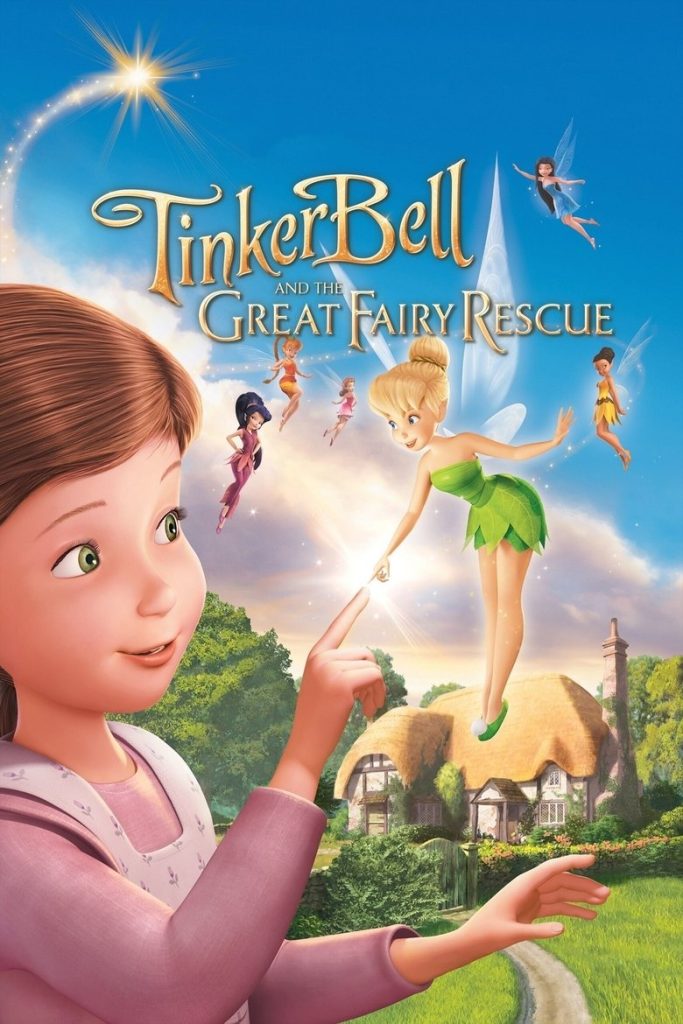
Tinker Bell and the Great Fairy Rescue is a 2010 animated adventure where Tinker Bell, while exploring a human girl's fairy house during a summer trip to the mainland, is accidentally discovered. As a fierce storm approaches, the other fairies, led by the bold Vidia, embark on a daring rescue mission. Meanwhile, Tink forms a meaningful friendship with the lonely girl, highlighting themes of curiosity, bravery, and connection.
Parent Guide
A family-friendly animated film with no significant content concerns, focusing on adventure, friendship, and mild peril in a fantasy setting. Suitable for viewers of all ages, especially young children.
Content breakdown
Includes scenes of peril during a storm and rescue sequences, such as fairies navigating windy conditions and a human capturing Tinker Bell, but all resolved without harm or violence.
The storm scenes with thunder, lightning, and strong winds might be slightly intense for very sensitive young children, but they are brief and not graphic.
No offensive or inappropriate language; dialogue is clean and suitable for all ages.
No sexual content or nudity; characters are modestly dressed in fairy or human attire.
No depiction of alcohol, drugs, or substance use.
Emotional moments include Tink's initial fear when discovered and the girl's loneliness, but these are balanced with uplifting themes of friendship and rescue.
Parent tips
This G-rated film is suitable for all ages, featuring gentle fantasy elements and positive messages about friendship and teamwork. It includes mild peril during storm scenes and rescue sequences, which might be slightly intense for very young children but are resolved safely. No concerning content in language, substance use, or sexual themes. Ideal for family viewing, it encourages discussions about empathy and helping others.
Parent chat guide
Parent follow-up questions
- What was your favorite fairy in the movie?
- How did Tinker Bell and the girl become friends?
- What sounds did the storm make?
- Why do you think Vidia helped with the rescue even though she's sometimes brash?
- What would you do if you found a fairy like Tink?
- How did the fairies work together to save Tinker Bell?
- What does this movie teach about overcoming loneliness?
- Compare Tink's curiosity to the girl's—how are they similar?
- Discuss the role of nature (like the storm) in the story.
- Analyze the themes of discovery and rescue in the film—what broader messages do they convey?
- How does the animation style enhance the fantasy elements?
- Reflect on how the movie portrays human-fairy interactions as a metaphor for cross-cultural understanding.
🎭 Story Kernel
At its core, 'Tinker Bell and the Great Fairy Rescue' is less about a simple rescue mission and more about the perilous negotiation between two worlds of belief. The film explores what happens when the secret, magical world of fairies—which exists on the precondition of human disbelief—is forced into direct contact with its supposed antithesis: a curious, believing child. Lizzy's unwavering faith in fairies doesn't just threaten exposure; it fundamentally challenges the fairies' self-imposed isolation. Tinker Bell's arc is driven by a desire for genuine connection and validation beyond her tinkering skills, finding it in the one human who can offer it. The real conflict isn't villainy, but the clash between protective secrecy and the transformative, risky power of being truly known.
🎬 Visual Aesthetics
The film employs a distinct visual duality to separate the human and fairy realms. The human world, particularly Dr. Griffiths' cottage and laboratory, is rendered in warmer, earthy browns and softer lighting, suggesting a grounded, if slightly dusty, reality. In contrast, Pixie Hollow and fairy scenes burst with a hyper-saturated, luminous color palette—vibrant greens, crystalline blues, and sparkling light effects—creating a sense of heightened, magical perception. The camera often adopts a low-angle perspective when focusing on fairies, emphasizing their small scale and the looming grandeur of the human world. This visual language reinforces the theme of perspective: what is mundane to humans is a vast, dangerous landscape to fairies.
🔍 Details & Easter Eggs
💡 Behind the Scenes
This was the third film in Disney's Tinker Bell direct-to-video franchise. Mae Whitman, who voiced Tinker Bell, has noted the challenge of conveying the character's wide emotional range—from stubborn pride to vulnerable fear—primarily through voice work. The film's director, Bradley Raymond, previously worked on Disney's 'The Hunchback of Notre Dame' and 'Hercules,' bringing experience with larger-than-life stories to this smaller-scale, character-driven fairy tale. Animation focused heavily on creating believable, organic interactions between the CGI fairies and the more textured, realistic environments of the English countryside setting.
Where to watch
Choose region:
- Disney Plus
- Amazon Video
- Apple TV Store
- Google Play Movies
- YouTube
- Fandango At Home
Trailer
Trailer playback is unavailable in your region.