
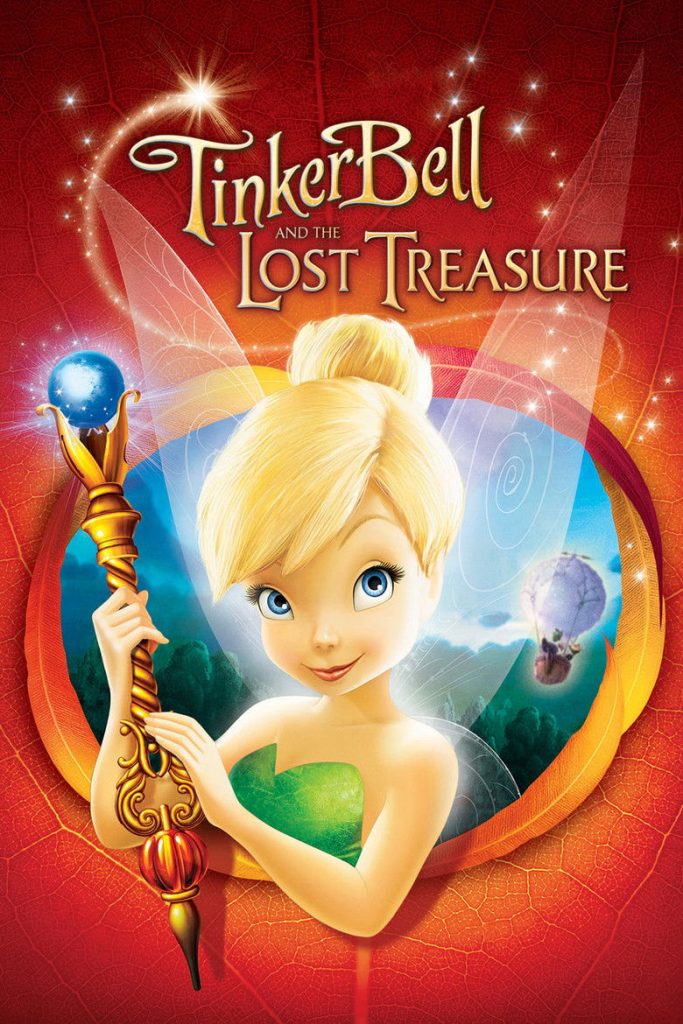
Tinker Bell and the Lost Treasure (2009)
Story overview
In this animated adventure, Tinker Bell's impulsive actions accidentally endanger Pixie Hollow's magical Pixie Dust Tree. To restore it, she must embark on a perilous journey across the sea to find a lost treasure before the rare blue harvest moon passes. Along the way, she learns valuable lessons about responsibility, friendship, and perseverance.
Parent Guide
This gentle animated adventure is completely appropriate for all ages with positive messages about responsibility and friendship. The G rating accurately reflects its family-friendly content.
Content breakdown
Some mild fantasy peril when Tinker Bell faces obstacles on her journey, including navigating rough waters and encountering non-threatening creatures. No actual violence or harm occurs.
No scary or disturbing content. The animation is bright and cheerful throughout, with friendly characters and a positive tone.
No inappropriate language. All dialogue is polite and age-appropriate.
No sexual content or nudity. Characters are modestly dressed fairies in typical fairy attire.
No substance use of any kind.
Mild emotional moments when Tinker Bell realizes she's made a serious mistake and feels guilty. The resolution is happy and uplifting.
Parent tips
This G-rated film is suitable for all ages with minimal concerning content. The main themes revolve around taking responsibility for mistakes, teamwork, and problem-solving. The adventure elements are mild and fantasy-based. Consider discussing how Tinker Bell handles her mistake and what children can learn about fixing problems they create.
Parent chat guide
Parent follow-up questions
- What was your favorite fairy in the movie?
- Can you tell me about Tinker Bell's special talent?
- How did Tinker Bell fix her big mistake?
- Why was the Pixie Dust Tree so important to the fairies?
- What made Tinker Bell's journey across the sea difficult?
- How did Tinker Bell show she was a good friend?
- What does this story teach us about the consequences of our actions?
- How did Tinker Bell demonstrate problem-solving skills?
- What qualities make someone a good team member like in the movie?
- How does the film portray the theme of redemption?
- What cultural elements from different countries might be represented in the animation?
- How does Tinker Bell's character development reflect real-life growth?
🎭 Story Kernel
At its core, 'Tinker Bell and the Lost Treasure' explores the tension between rigid perfectionism and creative resilience. Tinker Bell's quest isn't really about fixing the moonstone—it's about her learning that true craftsmanship isn't flawless execution but the ability to transform mistakes into something new. Her obsession with following instructions perfectly mirrors how institutional systems can stifle innovation. The film cleverly subverts the 'chosen one' narrative by having Tinker Bell fail spectacularly, then discover that her real talent lies not in following blueprints but in improvising solutions. The broken moonstone becomes more beautiful when reassembled with creativity rather than rigid adherence to tradition.
🎬 Visual Aesthetics
The film employs a distinct autumnal color palette of golds, ambers, and deep oranges that visually represents both the harvest season and Tinker Bell's personal transformation. Camera work frequently uses close-ups on Tinker Bell's hands as she works, emphasizing her identity as a tinker. The animation of the moonstone's light has a liquid, organic quality that contrasts with the rigid mechanical devices Tinker Bell initially creates. When the moonstone shatters, the shards scatter in a precise geometric pattern that foreshadows how they'll be reassembled. The Northern Lights sequence uses swirling, painterly textures that break from the more defined lines of Pixie Hollow.
🔍 Details & Easter Eggs
💡 Behind the Scenes
This was the first Tinker Bell film where Mae Whitman voiced the character, taking over from previous voice actors. The animators studied real autumn leaves under microscopes to create the detailed falling leaf sequences. Director Klay Hall insisted on practical light studies for the moonstone effects, with animators using actual crystals to understand light refraction. The film's score incorporates Celtic instrumentation to emphasize the autumnal and mythical elements. Production coincided with technological upgrades at DisneyToon Studios, allowing for more complex particle effects in scenes like the Northern Lights.
Where to watch
Choose region:
- Disney Plus
- Amazon Video
- Apple TV Store
- Google Play Movies
- YouTube
- Fandango At Home
Trailer
Trailer playback is unavailable in your region.