
Toy Story (1995)
Story overview
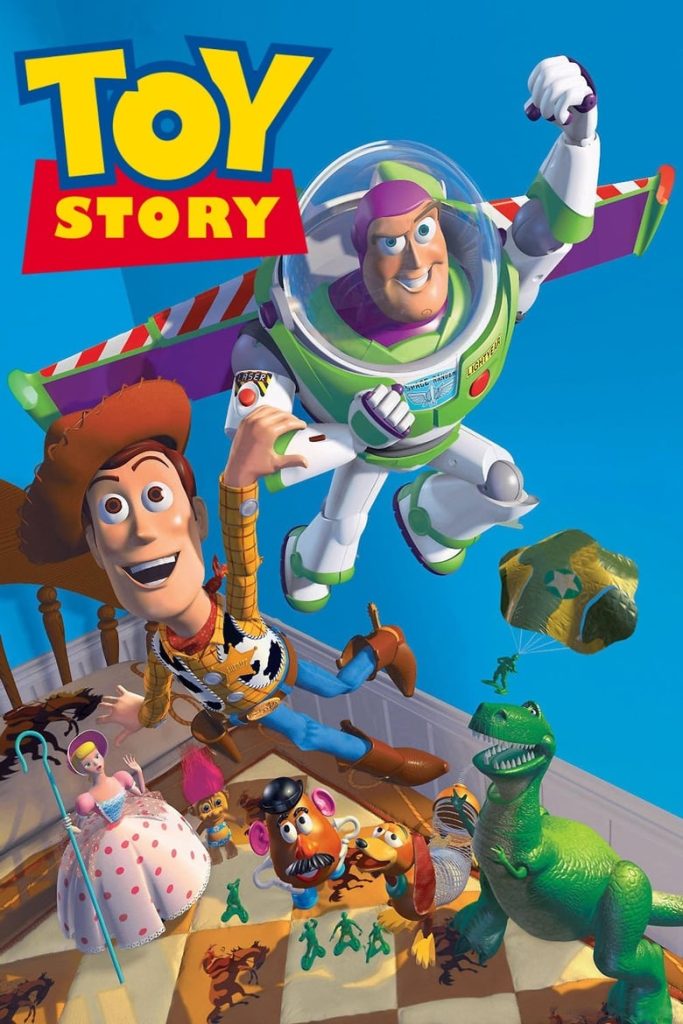
Toy Story follows the toys in a young boy's room who come to life when humans aren't present. Woody, the favorite cowboy doll, feels threatened when a new space ranger action figure named Buzz Lightyear arrives. Their rivalry leads to adventures beyond the bedroom as they navigate jealousy, friendship, and finding their way back home. The story explores themes of loyalty, acceptance, and working together despite differences.
Parent Guide
A charming animated adventure with positive messages about friendship and teamwork, appropriate for most children.
Content breakdown
Some scenes involve toys in perilous situations, including being threatened by a destructive neighbor child and facing separation from their owner. No actual violence occurs between characters.
A few tense moments when toys face potential harm or separation, and a neighbor child who mishandles toys might be slightly unsettling for very young viewers.
No offensive language or inappropriate dialogue.
No sexual content or nudity.
No depiction of substance use.
Some emotional moments involving jealousy, fear of replacement, and separation anxiety, but all resolved positively.
Parent tips
Toy Story is a delightful animated film suitable for most children, featuring imaginative play and positive messages about friendship. The G rating indicates it contains content generally appropriate for all ages, with no objectionable material. Parents should be aware that some scenes involve mild peril when toys face challenges like being separated from their owner or dealing with a destructive neighbor child, but these moments are resolved positively and serve the story's themes of teamwork and loyalty.
Parent chat guide
Parent follow-up questions
- How do you think the toys feel when Andy plays with them?
- What would you do if you had a new toy friend like Buzz?
- Why is it important to share our toys and friends?
- How did Woody's feelings change from the beginning to the end?
- What made Buzz and Woody become friends instead of rivals?
- Have you ever felt jealous like Woody did? How did you handle it?
- What does the movie teach us about handling change and new situations?
- How do the toys show loyalty to Andy even when he's not around?
- What qualities make someone a true friend versus just someone you know?
- How does the film explore themes of identity and purpose through Buzz's journey?
- What commentary does the movie make about materialism and consumer culture?
- How do the characters demonstrate emotional growth throughout their adventures?
🎭 Story Kernel
Toy Story is fundamentally about the terror of obsolescence in a world where love is conditional. Woody's journey isn't about defeating a villain, but confronting his own fragile identity when a shinier model threatens his purpose. Buzz Lightyear's tragicomic arc—from believing he's a space ranger to realizing he's mass-produced merchandise—mirrors every child's moment of disillusionment with fantasy. The real conflict is internal: how do you find value when you're literally designed to be replaced? The film suggests community and acceptance, not superiority, as the answer to existential dread.
🎬 Visual Aesthetics
Pixar's pioneering 3D animation uses a deliberately artificial aesthetic that reinforces the toys' reality. The human world is shot with wide angles and muted colors (Sid's house is all grays and browns), making the toys' vibrant plastic bodies pop as the true focal point. Camera work often mimics a child's perspective—low angles during play scenes, chaotic handheld movements during chases. The climactic rocket sequence uses stark contrasts: the cold blue night, the fiery rocket exhaust, and the desperate race against a literal ticking clock (the moving van) create palpable tension through pure visual storytelling.
🔍 Details & Easter Eggs
💡 Behind the Scenes
Tom Hanks recorded Woody's lines while suffering from a severe flu, giving the character's panicked scenes an authentically strained, feverish quality. The film was originally much darker—early scripts had Woody as a sarcastic, jealous villain, and Sid's dog was meant to die. Randy Newman's score was intentionally simple, using solo instruments like whistles and toy pianos to mirror a child's playtime. Animation breakthroughs included developing 'surface subdivision' to render organic shapes like Woody's plush body, which was notoriously difficult for 1995 CGI.
Where to watch
Choose region:
- Disney Plus
- Amazon Video
- Apple TV
- Google Play Movies
- YouTube
- Fandango At Home
Trailer
Trailer playback is unavailable in your region.