
Tummy Trouble (1989)
Story overview
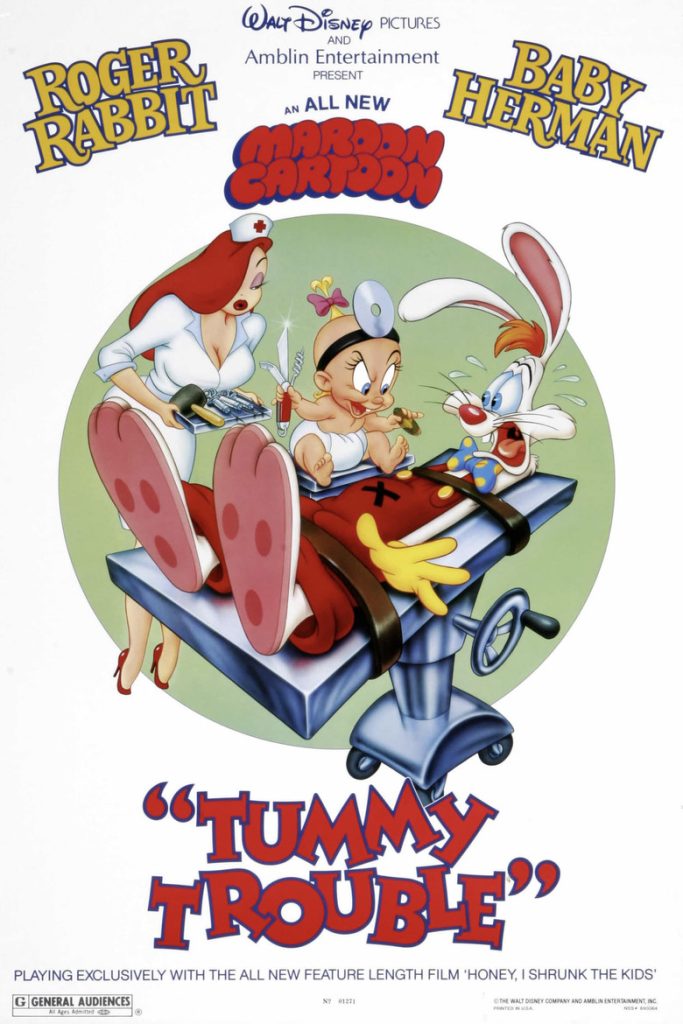
In this 1989 animated comedy short, Roger Rabbit is tasked with babysitting the mischievous Baby Herman. What starts as a simple babysitting job quickly turns into a series of slapstick misadventures as Roger tries to keep the curious baby out of trouble, leading to chaotic and humorous situations typical of classic cartoon antics.
Parent Guide
A harmless, classic cartoon short with slapstick comedy appropriate for all ages. The G rating accurately reflects its family-friendly content with no concerning elements.
Content breakdown
Cartoon-style slapstick violence only - characters get hit, fall down, or experience exaggerated physical comedy with no real danger or consequences. Typical of classic animation.
No scary or disturbing content. The tone is consistently lighthearted and comedic throughout.
No inappropriate language. Dialogue is family-friendly and typical of cartoon shorts.
No sexual content or nudity of any kind.
No substance use, smoking, or drinking depicted.
Mild emotional intensity from the chaotic babysitting situations, but everything resolves happily with no lasting tension.
Parent tips
This is a classic cartoon short with exaggerated physical comedy and slapstick humor. The G rating makes it appropriate for all ages, but very young children might find some of the chaotic scenes overwhelming. The runtime is only 7 minutes, making it perfect for a quick viewing. No content warnings needed beyond typical cartoon violence.
Parent chat guide
Parent follow-up questions
- What was your favorite part of the cartoon?
- Did Baby Herman remind you of anyone you know?
- What sounds did you hear in the movie?
- Why do you think Roger had so much trouble babysitting?
- What would you do differently if you were babysitting Baby Herman?
- What made you laugh the most in the cartoon?
- How does the animation style compare to modern cartoons?
- What does this cartoon teach us about responsibility?
- Why do you think slapstick humor was so popular in older cartoons?
- How does this short reflect the animation techniques of the late 1980s?
- What cultural references might younger viewers miss?
- How does the Roger Rabbit character fit into animation history?
🎭 Story Kernel
At its core, 'Tummy Trouble' explores the primal fear of bodily betrayal through the lens of slapstick comedy. The film isn't really about a baby swallowing a rattle—it's about the universal anxiety of losing control over one's own physical functions. Roger Rabbit's desperate attempts to retrieve the rattle mirror our own frantic efforts to maintain dignity when biology rebels. The characters are driven by escalating panic that transforms a simple problem into catastrophic proportions, revealing how easily rational thought collapses under the pressure of perceived emergencies. This isn't just a cartoon about digestion; it's an allegory for how small problems become monstrous through our own frantic reactions.
🎬 Visual Aesthetics
The animation employs exaggerated squash-and-stretch techniques that make Roger's body appear almost liquid as it contorts through various digestive tract adventures. The color palette shifts dramatically from the bright, primary-colored hospital exterior to the surreal, organic hues inside Baby Herman's body—creating a visual journey from clinical reality to biological nightmare. Camera angles frequently adopt low perspectives that emphasize Roger's vulnerability, while rapid cuts during chase sequences create a breathless, chaotic energy. The X-ray sequences provide clever visual punctuation, transforming internal processes into comic spectacle through stark black-and-white contrast against the colorful animation.
🔍 Details & Easter Eggs
💡 Behind the Scenes
This Roger Rabbit short was created as a pre-feature attraction for Disney's 'Honey, I Shrunk the Kids' in 1989. Animators studied medical textbooks for the digestive tract sequences but exaggerated proportions for comedic effect. The baby's crying was achieved by recording an actual infant, then pitch-shifting the audio. Director Rob Minkoff would later helm 'The Lion King,' and you can see early experiments with dramatic timing that would define his feature work. The short marked one of the final appearances of Roger Rabbit before the character faded from prominence.
Where to watch
Choose region:
- Disney Plus