
Unknown: Cave of Bones (2023)
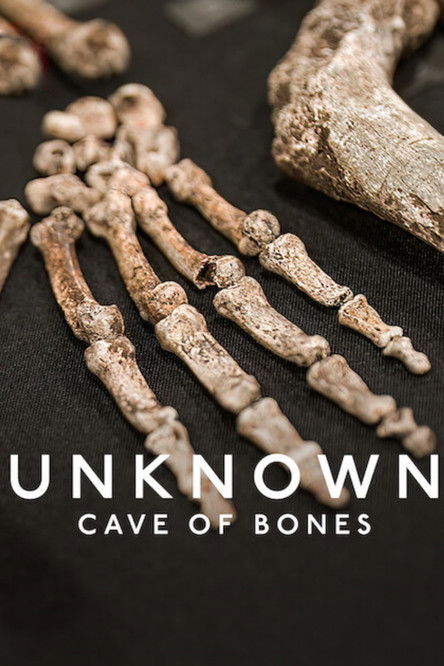
Story overview
This documentary explores ancient human history through scientific examination of 250,000-year-old cave remains, focusing on what makes us human. It's an educational film suitable for family viewing with mild thematic elements.
Parent Guide
Educational documentary suitable for most families with children 8+. Contains scientific discussions of ancient human remains and evolution.
Content breakdown
No violence or peril depicted. The film focuses on scientific examination of ancient remains.
Contains images of ancient human skeletal remains and discussions about death. Some children might find these images unsettling.
No inappropriate language. Uses scientific and educational terminology.
No sexual content or nudity.
No substance use depicted.
Themes of human mortality and evolution might provoke thoughtful questions but are presented in an educational, non-disturbing manner.
Parent tips
This documentary contains scientific discussions about ancient human remains and evolution. While educational, younger children might find the skeletal images or discussions about death unsettling. Best for children 8+ who can handle scientific content.
Parent chat guide
Parent follow-up questions
- Did you see any bones in the cave?
- What tools did the scientists use?
- What animals might have lived long ago?
- How do scientists know how old the bones are?
- What can we learn from ancient remains?
- How are early humans different from us?
- What methods do scientists use to date ancient remains?
- How does this discovery change our understanding of human evolution?
- What ethical considerations exist when studying ancient human remains?
- How does this discovery challenge traditional views of human intelligence?
- What can ancient burial practices tell us about early human cognition?
- How do scientific discoveries about our past influence modern society?
🎭 Story Kernel
The film explores the radical hypothesis that Homo naledi, a creature with a brain the size of an orange, practiced intentional burial and symbolic art. It challenges the long-held paleoanthropological dogma that complex cognitive behaviors are exclusive to large-brained species like Homo sapiens. By following Lee Berger’s team into the treacherous Rising Star cave system, the documentary shifts from a mere archaeological survey to a philosophical inquiry into the origins of meaning, spirituality, and the human spark. It posits that the drive to honor the dead and leave a mark on the world is an ancient, biological impulse rather than a late-stage cultural achievement, effectively rewriting the timeline of evolutionary psychology and forcing a re-evaluation of what it truly means to be human and the nature of the soul.
🎬 Visual Aesthetics
Mark Mannucci employs a visual language defined by extreme physical constraint and high-contrast lighting. The cinematography utilizes body-mounted cameras and tight close-ups to convey the suffocating reality of the Superman’s Crawl, making the viewer feel the literal weight of the earth. This claustrophobia is juxtaposed with the ethereal, almost sacred glow of headlamps illuminating the Dinaledi Chamber, transforming a dusty pit into a cathedral of bones. The use of 3D mapping and digital reconstructions provides a clinical clarity that balances the raw, handheld footage of the excavation. Symbolically, the transition from the bright, expansive South African landscape to the pitch-black subterranean depths mirrors the journey from known history into the murky, unmapped regions of our evolutionary past, where light only reaches what we are brave enough to uncover.
🔍 Details & Easter Eggs
💡 Behind the Scenes
Unknown: Cave of Bones is a standout installment in Netflix’s Unknown four-part docuseries, which explores various frontiers of science and exploration. Director Mark Mannucci focuses heavily on the charismatic and often polarizing figure of Lee Berger. A significant production fact is that Berger, who previously could not fit through the cave's narrowest passages, underwent a strict physical regimen to lose weight specifically to witness the burials firsthand. The film’s release coincided with a flurry of scientific papers that sparked intense debate within the paleoanthropology community regarding the validity of the burial and art claims.
Where to watch
Choose region:
- Netflix
- Netflix Standard with Ads
Trailer
Trailer playback is unavailable in your region.