
Voices (2025)
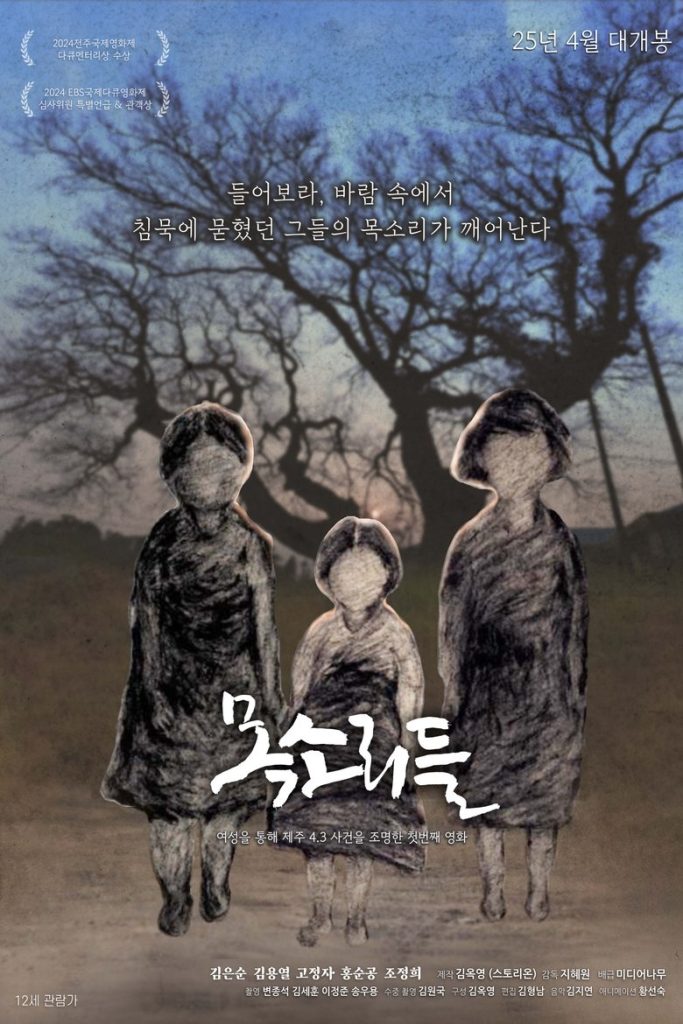
Story overview
This documentary explores the Jeju 4.3 incident in South Korea (1948-1954), where an estimated 25,000-30,000 people died, focusing on the often-overlooked experiences of women victims. Through historical research and survivor accounts, it reveals their stories of loss and resilience during this turbulent period.
Parent Guide
A serious historical documentary about mass violence and its impact on women. Suitable for mature teens with guidance, but likely too intense for younger children due to emotional content about death and suffering.
Content breakdown
Discusses historical violence including killings and massacres, but likely shows archival footage and interviews rather than graphic reenactments. Descriptions of violence may be detailed.
Themes of death, loss, and historical trauma could be disturbing. May include emotional survivor testimonies and discussions of mass graves. Not visually graphic but emotionally heavy.
Documentary in Korean with subtitles. No offensive language expected in educational context.
No sexual content or nudity expected in this historical documentary.
No substance use depicted or discussed.
High emotional intensity due to themes of mass death, grief, and historical injustice. Survivor testimonies and discussions of trauma may be emotionally challenging.
Parent tips
This documentary deals with historical trauma and mass violence. Preview it first to assess if it's appropriate for your child's maturity level. Be prepared to discuss difficult topics like war, death, and human rights violations. The content may be emotionally heavy for sensitive viewers.
Parent chat guide
Parent follow-up questions
- What did you see in the pictures?
- How do you think the people felt?
- Why is it important to remember what happened long ago?
- What can we learn from these women's stories?
- How do documentaries help us understand history?
- Why might some stories be hidden or forgotten?
- What responsibilities do we have when learning about historical trauma?
- How does gender affect how we remember historical events?
🎭 Story Kernel
Beyond the surface of a standard cultural documentary, 'The Voices' delves into the existential weight of the Haenyeo’s labor. It isn't just about the act of diving; it’s about the 'Haenyeo Norae' (songs) that serve as both a rhythmic guide for work and a vessel for collective sorrow and resilience. Jee Hye-won captures how these songs are tethered to the physical environment of Jeju Island. The film expresses the urgency of documenting a vanishing oral history, where the 'voices' are not merely sounds but the final echoes of a matriarchal labor culture. It explores the paradox of a life lived between the crushing pressure of the deep sea and the liberating release of the surface, framing the songs as the bridge between survival and artistic expression in the face of modernization.
🎬 Visual Aesthetics
The cinematography employs a stark, observational style that avoids the romanticized 'travelogue' aesthetic often associated with Jeju. Instead, it focuses on the raw textures of the environment—the jagged volcanic rocks, the murky depths of the ocean, and the deep-set wrinkles on the divers' faces. Symbolism is found in the rhythmic movement of the tides, mirroring the cadence of the Haenyeo’s songs. The camera often lingers on the 'Sumbisori'—the high-pitched whistle made when the divers surface—treating it as a haunting, non-verbal musical motif. This visual and auditory focus emphasizes the physical toll of the profession, where the beauty of the landscape is constantly juxtaposed with the harsh reality of manual labor and the aging bodies of the practitioners who remain the last keepers of this tradition.
🔍 Details & Easter Eggs
💡 Behind the Scenes
Director Jee Hye-won is known for her deep dives into Korean cultural subjects, previously gaining acclaim for 'The Birth of Resonance.' For 'The Voices,' the production team spent significant time building trust with the Haenyeo communities in Jeju to capture authentic, unscripted moments. The film was featured at various international documentary festivals, highlighting the global interest in the UNESCO-recognized Haenyeo culture. It serves as a companion piece to the broader efforts in South Korea to preserve the unique linguistic and musical dialects of Jeju Island, which are currently classified as critically endangered by UNESCO.
Where to watch
Choose region:
- Netflix
- Netflix Standard with Ads