What Happened to Monday (2017)
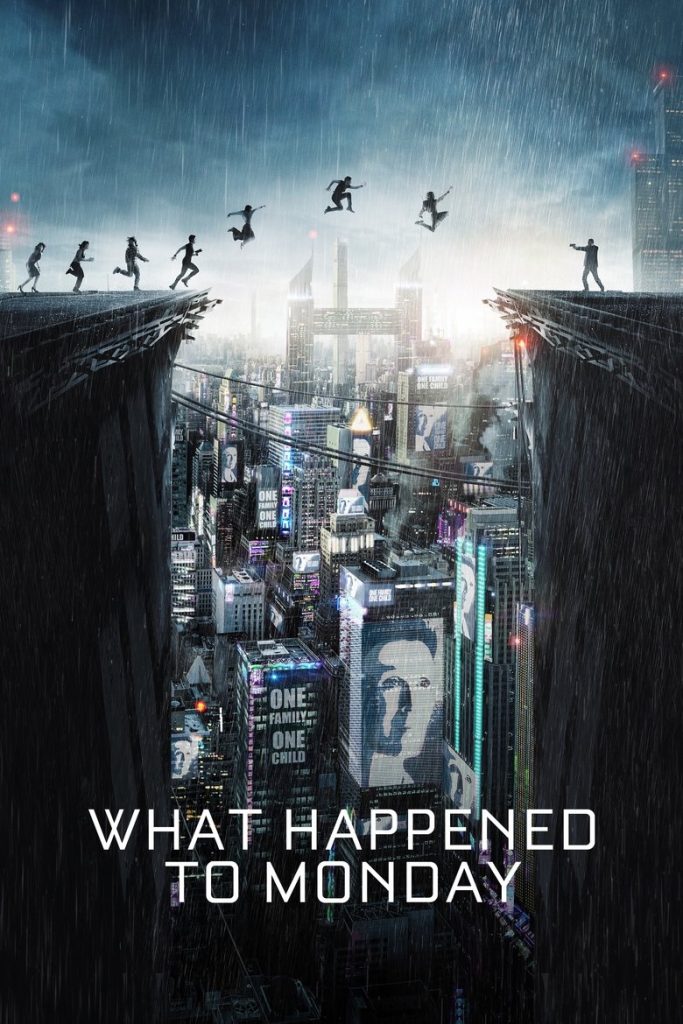
Story overview
In a dystopian future where overpopulation has led to a strict one-child policy enforced by the government, seven identical sisters must hide their existence by sharing one public identity. Each sister can only leave their apartment on her designated day of the week, living as 'Karen Settman' on that specific day. When Monday mysteriously disappears, the remaining sisters must work together to uncover what happened while maintaining their secret and evading government authorities who are determined to enforce the population control laws.
Parent Guide
A dystopian thriller with intense action sequences, violent confrontations, and mature themes about government control and family survival. Best suited for mature teens and adults.
Content breakdown
Contains intense action sequences, gun violence, hand-to-hand combat, and scenes of peril. Characters are pursued, captured, and face life-threatening situations. Some violent deaths occur.
The dystopian setting creates a tense atmosphere throughout. Scenes of government oppression, family separation, and characters in hiding may be disturbing. The premise of enforced population control and its consequences creates psychological tension.
Contains some strong language and profanity typical of thriller/action films. Language is not excessive but includes occasional strong words.
Minimal sexual content. Some romantic tension between characters but no explicit scenes. Occasional suggestive dialogue.
Occasional social drinking by adult characters in background scenes. No prominent drug use or substance abuse depicted.
High emotional stakes throughout as sisters risk their lives to protect each other. Themes of loss, sacrifice, and family loyalty create intense emotional moments. The dystopian oppression creates sustained tension.
Parent tips
This film presents a thought-provoking science fiction scenario that explores themes of identity, family loyalty, and government control. The dystopian setting and high-stakes premise create significant tension throughout, with scenes of peril, violence, and intense emotional moments that may be disturbing for younger viewers. Parents should be prepared to discuss the film's central ethical questions about population control, individual rights, and the sacrifices people make for family.
Parent chat guide
Parent follow-up questions
- What did you think about the sisters in the movie?
- How did the sisters help each other?
- What was your favorite part of the movie?
- How would you feel if you had to share your name with someone else?
- What do you think makes a family special?
- Why do you think the government made the rule about only having one child?
- How did the sisters work together to solve their problem?
- What would you do if you had to hide like the sisters did?
- How did the sisters show they cared about each other?
- What was the most exciting part of the movie for you?
- What do you think about the government's policy in the movie? Is it ever okay for governments to control family size?
- How did each sister contribute to keeping their secret safe?
- What challenges did the sisters face by sharing one identity?
- How did the movie make you think about your own family relationships?
- What would you have done differently if you were one of the sisters?
- What ethical questions does this film raise about population control and individual rights?
- How does the film explore the tension between personal identity and collective survival?
- What commentary might the film be making about current environmental and population concerns?
- How do the sisters' different personalities and approaches help or hinder their situation?
- What does the film suggest about the limits of government authority and personal freedom?
🎭 Story Kernel
At its core, 'What Happened to Monday' is a brutal exploration of identity under totalitarian efficiency. The film's real engine isn't the mystery of Monday's disappearance, but the ethical calculus of the Child Allocation Act. It asks: when survival requires the erasure of self, what remains of the individual? The sisters aren't driven by grand rebellion initially, but by a primal, shared instinct to protect their collective existence. Their tragedy lies in becoming exactly what the system fears—multiple entities competing for one life—while revealing that the system's 'order' is maintained through the same ruthless, sibling-against-sibling violence it claims to prevent.
🎬 Visual Aesthetics
The film employs a stark, sterile visual language for the public sphere—cool blues, harsh whites, and oppressive symmetrical compositions that mirror the rigid control of the Child Allocation Bureau. In contrast, the sisters' apartment is a warm, cluttered haven of earthy tones and personalized chaos, visually representing their hidden humanity. The action is brutal and functional, not stylish, emphasizing the desperate, survivalist violence of their situation. Clever use of split-screen and mirrored shots early on subtly reinforces their duality and connection, while the later singular frames of Noomi Rapace playing against herself are a technical triumph in selling the illusion of seven distinct personalities.
🔍 Details & Easter Eggs
💡 Behind the Scenes
Noomi Rapace performed a staggering feat, portraying all seven sisters. The production used advanced motion control rigs and extensive pre-planning, with Rapace often acting opposite stand-ins or markers, then replaying the scene precisely to act against her own previously captured performance. The distinctive, practical apartment set was built on a soundstage to allow for the complex camera work needed to sell the multi-character scenes. Director Tommy Wirkola cited classic siege films and the paranoid thrillers of the 70s as visual inspirations, wanting the sci-fi elements to feel grounded in a tangible, bureaucratic reality.
Where to watch
Choose region:
- Netflix
- Netflix Standard with Ads
Trailer
Trailer playback is unavailable in your region.