
When We First Met (2018)
Story overview
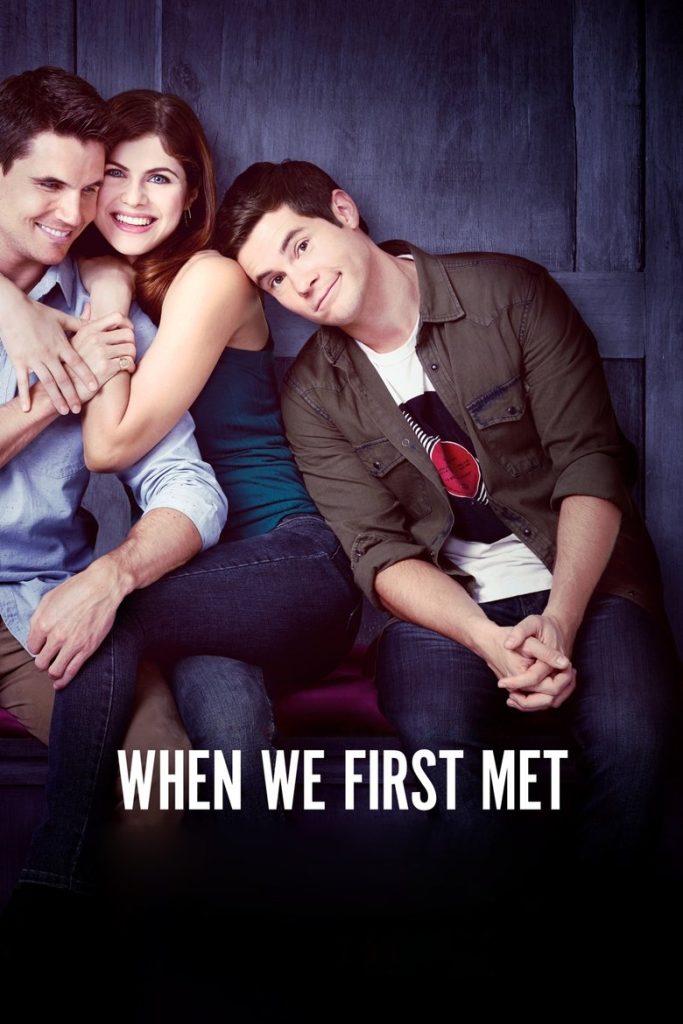
When We First Met is a 2018 romantic comedy fantasy film directed by Ari Sandel. The story follows Noah (Adam Devine), who meets Avery (Alexandra Daddario) at a Halloween party and instantly falls for her, but she only sees him as a friend. Three years later, Avery is engaged to someone else. Through a magical photo booth that transports him back in time to the night they first met, Noah repeatedly relives that evening, trying different approaches to win Avery's heart. The film explores themes of friendship, timing, and self-discovery through its time-loop premise.
Parent Guide
A lighthearted romantic comedy with fantasy elements suitable for families with children ages 8 and up. Contains mild romantic content, occasional mild language, and social drinking in party settings.
Content breakdown
No violence or physical peril. The time-travel elements are presented as magical and comedic rather than dangerous.
Nothing scary or disturbing. The fantasy elements are gentle and humorous.
Occasional mild language including 'hell,' 'damn,' and 'ass.' No strong profanity.
Some kissing and romantic situations. Characters discuss relationships and attraction. No nudity or explicit sexual content.
Social drinking at parties and bars. Characters are shown with alcoholic beverages in social settings. No drunkenness or substance abuse.
Mild romantic tension and disappointment. Some scenes show characters feeling rejected or uncertain about relationships. Overall tone remains light and comedic.
Parent tips
This lighthearted romantic comedy is appropriate for most families with children ages 8 and up. The time-travel fantasy elements are gentle and comedic rather than intense. Parents should be aware of some mild romantic content including kissing and discussions about relationships. The film contains occasional mild language and social drinking scenes typical of adult party settings. The overall message emphasizes personal growth and learning to accept what cannot be changed.
Parent chat guide
Parent follow-up questions
- What was your favorite costume in the movie?
- What was funny about the photo booth?
- How did Noah try to be a good friend?
- Why do you think Noah kept going back in time?
- What did Noah learn about being himself instead of pretending?
- How did Avery show she was a good friend to Noah?
- What does the film suggest about the difference between friendship and romance?
- How did Noah's understanding of what makes someone happy change?
- What message does the film send about accepting things we cannot change?
- How does the film explore the concept of 'the one who got away'?
- What commentary does the film make about idealized versions of people versus reality?
- How does the time-loop device serve as a metaphor for regret and second chances?
🎭 Story Kernel
At its core, 'When We First Met' explores the fallacy of perfect romantic orchestration versus authentic connection. Noah's obsessive time-loop journey isn't truly about winning Avery's love—it's about his own ego's need to validate his initial perception of their 'destiny.' The film cleverly subverts the typical rom-com premise by revealing that Noah's various personas (musician, finance bro, artist) all fail because they're performances designed to manipulate an outcome, not expressions of his genuine self. The real breakthrough comes when he stops trying to recreate 'the perfect night' and instead helps Avery pursue her actual happiness with Ethan, discovering his own compatible match in Carrie through unforced, present-moment connection. It's ultimately about releasing control and allowing relationships to develop organically.
🎬 Visual Aesthetics
The film employs a distinct visual language to differentiate timelines while maintaining romantic comedy warmth. The initial 'perfect night' is bathed in golden-hour lighting and soft focus, creating a nostalgic, almost dreamlike quality that Noah tries to recapture. Subsequent loops introduce subtle visual cues—changing outfits, slightly altered camera angles in repeated scenes, and evolving background details—that signal temporal shifts without heavy-handed effects. The color palette shifts from warm ambers during Noah's attempts to cooler, more natural tones as he moves toward authenticity. Particularly effective is the repeated framing of the photo booth, which becomes a visual anchor point whose changing occupants chart the emotional journey from obsession to resolution.
🔍 Details & Easter Eggs
💡 Behind the Scenes
Adam Devine (Noah) and Alexandra Daddario (Avery) had immediate chemistry during their audition scene, which reportedly convinced producers to cast them despite initial concerns about their height difference. The iconic photo booth scenes were filmed with a functional vintage booth sourced from a collector, requiring precise timing for the flash effects. Director Ari Sandel intentionally avoided overt CGI for the time-loop transitions, preferring practical changes in wardrobe, lighting, and background extras to create the temporal shifts. The jazz bar set was built on a soundstage but designed to replicate actual New Orleans venues where the story is set.
Where to watch
Choose region:
- Netflix
- Netflix Standard with Ads
Trailer
Trailer playback is unavailable in your region.