
While You Were Sleeping (1995)
Story overview
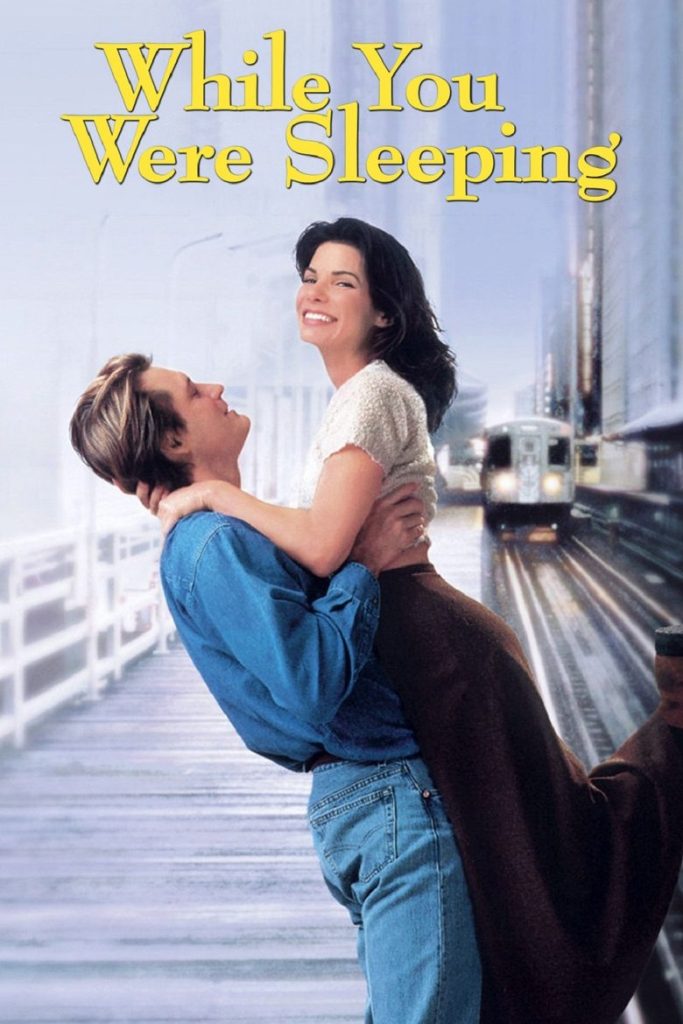
While You Were Sleeping is a 1995 romantic comedy about a lonely Chicago transit worker who saves a handsome commuter from an accident. When he falls into a coma, she is mistaken for his fiancée by his family and goes along with the charade. As she gets to know his warm, quirky family, she develops feelings for his brother, leading to a charming mix of mistaken identity and heartfelt romance. The film explores themes of loneliness, family connections, and finding love in unexpected places.
Parent Guide
A gentle romantic comedy suitable for most families with children 8+, focusing on mistaken identity and family relationships with minimal concerning content.
Content breakdown
Brief scene of a man falling onto train tracks (not graphic), and comatose patient situation that might concern sensitive children.
Hospital setting with comatose patient could be slightly unsettling for some children, but handled lightly.
Occasional mild exclamations and very light profanity typical of PG-rated films from this era.
Brief kissing scenes, romantic conversations, and mild flirtation. No nudity or explicit content.
No depiction of alcohol, drugs, or tobacco use.
Some emotional scenes involving loneliness, deception guilt, and romantic tension, but overall lighthearted tone.
Parent tips
This PG-rated romantic comedy is generally family-friendly with minimal concerning content. The central premise involves deception as the main character pretends to be engaged to a comatose man, which could prompt discussions about honesty and its consequences. The film's gentle humor and focus on family relationships make it accessible for older children, though younger viewers might not fully grasp the romantic complexities.
Parents should note that while there's no explicit content, the film does involve some emotional manipulation through the deception plotline. The romantic elements are sweet and chaste, with only brief kissing scenes. The comatose patient situation might be slightly unsettling for very sensitive children, though it's handled with lightheartedness rather than medical realism.
Parent chat guide
Explore the family dynamics shown in the film - how the family welcomes a stranger with open arms, and what this says about trust and acceptance. For older children, you might discuss the ethical implications of the deception and whether the ends justified the means in this romantic scenario.
Parent follow-up questions
- What was your favorite funny part in the movie?
- How did the family make the main character feel welcome?
- What would you do if you found something that didn't belong to you?
- Why do you think Lucy pretended to be Peter's fiancée?
- How did telling one lie lead to more problems?
- What makes someone part of a family?
- What were the consequences of Lucy's deception on the family?
- How did Jack's feelings change throughout the movie?
- What does the movie show about being honest even when it's difficult?
- How does the film handle the ethical dilemma of Lucy's deception?
- What commentary does the movie make about loneliness and social connection?
- How realistic do you find the romantic resolution given the circumstances?
🎭 Story Kernel
At its core, 'While You Were Sleeping' explores the human need for belonging versus the prison of loneliness. Lucy's initial lie about being Peter's fiancée isn't malicious scheming—it's a desperate grasp at connection in a world where she feels invisible. The film cleverly subverts romantic comedy tropes by having the 'real' romance develop with the wrong brother, Jack, who sees Lucy's authentic self rather than the fantasy she's created. Every character is driven by their own isolation: Lucy by her solitary existence, Jack by living in his brother's shadow, the Callaghan family by their grief over losing Peter's mother. The movie argues that sometimes we need to create a fiction to discover our truth, and that family isn't just blood—it's who shows up when you're vulnerable.
🎬 Visual Aesthetics
The film's visual language masterfully mirrors Lucy's emotional journey through Chicago's stark winter landscape. Director Jon Turteltaub uses cold, blue-tinged cinematography in the early scenes—the lonely L train, the sterile ticket booth, the icy river—to visualize Lucy's emotional isolation. As she enters the warm, chaotic Callaghan household, the palette shifts to golden yellows and rich browns, with handheld camerawork capturing the family's comforting chaos. Key visual motifs include windows (Lucy watching life from outside), circular compositions (the family gathered around tables), and the recurring L train representing life's monotonous routine. The hospital scenes use sterile whites that gradually warm as Lucy's connection to the family deepens, visually tracking her thawing emotional state.
🔍 Details & Easter Eggs
💡 Behind the Scenes
Sandra Bullock was actually the studio's second choice for Lucy—they initially wanted Demi Moore, who turned it down. The iconic 'You look like a penis' line was improvised by Bill Pullman during rehearsal and kept in the final cut. Chicago's bitter winter caused numerous production delays, with temperatures dropping to -20°F during the L train platform scenes. The Callaghan family home scenes were filmed in a real Chicago brownstone, with the crew having to navigate narrow staircases with equipment. Peter Boyle (Ox) and Glynis Johns (Elsie) had never met before filming but developed such convincing chemistry that audiences believed they were a real long-married couple.
Where to watch
Choose region:
- Disney Plus
- Amazon Video
- Apple TV
- Google Play Movies
- YouTube
- Fandango At Home
Trailer
Trailer playback is unavailable in your region.