
White Elephant (2012)
Story overview
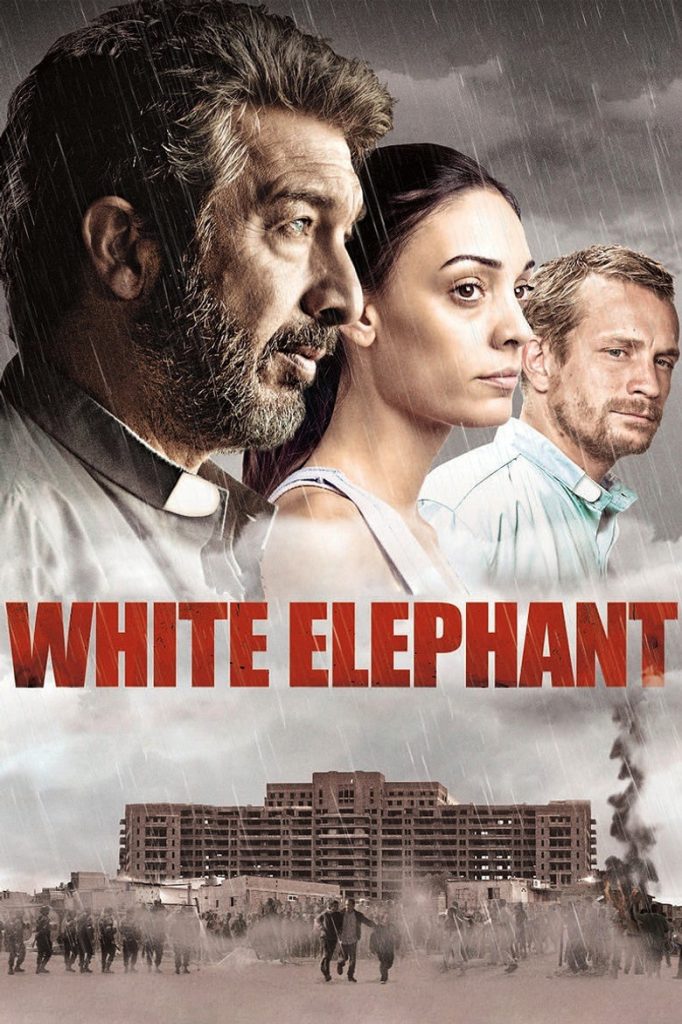
White Elephant is a 2012 Spanish-Argentine-French drama directed by Pablo Trapero. The film follows a troubled priest who, while working with a friend to build a hospital in a Buenos Aires shantytown, finds comfort and connection with a young atheist social worker. Set against the backdrop of urban poverty and social challenges, it explores themes of faith, doubt, community service, and personal redemption through quiet, character-driven storytelling.
Parent Guide
A thoughtful, slow-paced drama focusing on moral and existential themes in a gritty urban setting. Minimal objectionable content but requires maturity to appreciate its nuanced storytelling.
Content breakdown
Implied background violence related to poverty and crime (e.g., references to neighborhood dangers, tense atmospheres), but no on-screen violence, fights, or bloodshed.
Some scenes depict shantytown poverty and hardship, which might be sobering or sad. Emotional distress of characters dealing with guilt and doubt could be unsettling for sensitive viewers.
No strong profanity or offensive language noted; dialogue is in Spanish with possible mild expressions, but nothing aggressive or explicit.
No sexual content, nudity, or romantic scenes; relationships are platonic and focused on emotional connection.
No depiction of drinking, drugs, or smoking; characters are shown in sober, work-oriented contexts.
High emotional weight due to themes of faith, redemption, and social injustice. Characters experience guilt, doubt, and compassion in a realistic way, which may resonate deeply with older viewers.
Parent tips
This film deals with mature themes like poverty, faith crises, and social injustice in a realistic, low-key manner. It contains no graphic violence, strong language, or sexual content, but its emotional weight and slow pace may be challenging for younger viewers. Best suited for teens and adults who can engage with thoughtful dialogue and subtle character development.
Parent chat guide
Parent follow-up questions
—
—
- What did you notice about the neighborhood in the movie? How did people help each other?
- Why do you think the priest felt sad or confused sometimes?
- How does the film portray the challenges of poverty without being sensational? What might be realistic vs. dramatized?
- Discuss the priest's internal conflict: is faith strengthened or weakened by doubt? How does his relationship with the social worker influence this?
- What does the film suggest about the role of community projects in solving social problems? Are there limitations?
🎭 Story Kernel
At its core, 'White Elephant' is a brutal deconstruction of the savior complex within a warzone. The film isn't about saving a community; it's about the characters' desperate, often self-destructive, attempts to save their own souls from the moral decay of perpetual violence. Father Thomas is driven by a guilt so profound it manifests as a death wish disguised as martyrdom. Agent Burnett is propelled by a cold, procedural logic that shatters when faced with the human cost. Their clash isn't ideological, but existential—two broken men using the same crumbling city as a stage for their personal purgatories, where every 'noble' act only digs the grave deeper.
🎬 Visual Aesthetics
The film employs a grimy, desaturated palette, drowning the favela in concrete grays and sickly yellows, making the sudden bursts of crimson blood feel like violent punctuation. Cinematographer Alejandro Martinez uses handheld cameras not for chaotic energy, but for a weary, observational intimacy, as if the lens itself is exhausted. The action is brutally efficient—no stylized slow-motion, just the jarring, clinical finality of gunshots. Key symbolism lies in the verticality: constant low and high-angle shots trap characters between heaven and the hell they've made on earth, with the unfinished hospital tower serving as a literal and metaphorical scaffold of failed hopes.
🔍 Details & Easter Eggs
💡 Behind the Scenes
Lead actor Michael Rooker performed many of his own stunts, drawing on his past physical training. The favela scenes were shot in a real, partially inhabited neighborhood in Rio de Janeiro, with many extras being local residents, lending an authentic, tense atmosphere. Director Jesse V. Johnson insisted on practical effects for the gunshot wounds, using specialized squibs to achieve the film's visceral, impactful blood hits, contrasting with common digital effects.
Where to watch
Choose region:
- Netflix
- Netflix Standard with Ads
- Apple TV Store
- Google Play Movies
- YouTube
Trailer
Trailer playback is unavailable in your region.