
Widow Clicquot (2024)
Story overview
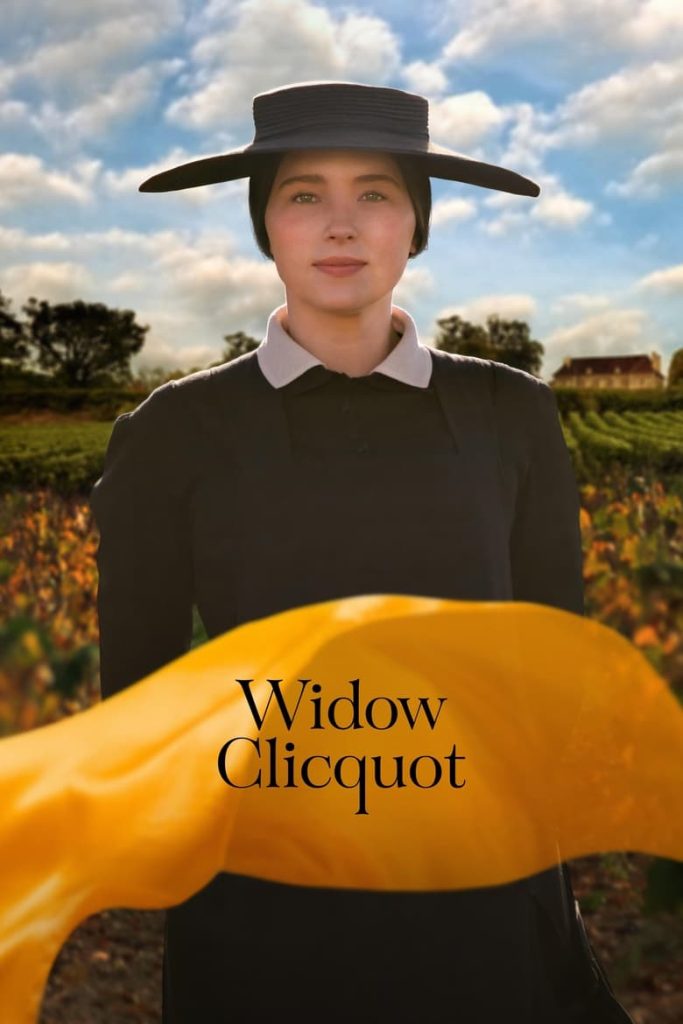
This historical drama portrays Madame Clicquot's journey as she takes over her late husband's wine business in 19th-century France, challenging societal norms to revolutionize the champagne industry and become a pioneering businesswoman. The film focuses on her determination, business acumen, and personal resilience in a male-dominated world.
Parent Guide
A historical drama about business innovation and gender equality with moderate emotional themes. Suitable for mature tweens and teenagers with parental guidance.
Content breakdown
No physical violence shown. Some tense business situations and societal pressure. Brief references to her husband's death (off-screen).
Themes of grief and loss may be emotionally affecting for sensitive viewers. Some scenes show the protagonist facing discrimination and opposition.
Occasional mild historical-era exclamations. No strong modern profanity.
Brief romantic moments and references to relationships. No explicit content or nudity.
Central theme involves champagne production and business. Characters drink wine/champagne in social and business contexts. Historical depiction of alcohol as part of industry.
Strong themes of grief, determination against odds, and societal pressure. The protagonist faces significant emotional challenges but demonstrates resilience.
Parent tips
This film is best suited for mature children and teenagers due to its complex themes and some adult content. Parents should be aware of: 1) Historical context of gender inequality and societal restrictions, 2) Moderate emotional intensity surrounding death and grief, 3) Some alcohol consumption depicted as part of the business setting, 4) Occasional mild language. The film offers valuable lessons about perseverance, innovation, and challenging stereotypes.
Parent chat guide
Parent follow-up questions
—
- What did Madame Clicquot make that was special?
- How did she help her family business?
- What was hard about being a businesswoman back then?
- Why was it unusual for a woman to run a business in the 1800s?
- What innovations did Madame Clicquot introduce to champagne making?
- How did she handle people who doubted her abilities?
- What can we learn from her persistence?
- How does the film portray gender roles and expectations in 19th-century Europe?
- What business strategies did Madame Clicquot use to succeed in a competitive industry?
- How does her personal grief influence her professional drive?
- What historical and social factors made her achievements particularly significant?
- How does this story relate to modern discussions about women in leadership?
🎭 Story Kernel
The film transcends the typical biopic structure by framing Barbe-Nicole Clicquot Ponsardin’s ascent not just as a business triumph, but as a radical act of preservation. Set against the backdrop of the Napoleonic Wars, the narrative explores the intersection of grief and innovation. Following the death of her husband, François, Barbe-Nicole defies the Code Napoléon, which stripped women of their rights, to safeguard their vineyard. The story is a dual-timeline exploration of her passionate, albeit turbulent, marriage and her solitary battle against both nature and a patriarchal trade. It expresses the idea that legacy is not merely inherited but meticulously cultivated through scientific rigor and stubborn resilience. The film highlights her revolutionary riddling method, positioning her as a pioneer who transformed a muddy, inconsistent beverage into the refined, clear champagne that defined a global luxury standard.
🎬 Visual Aesthetics
Cinematographer Caroline Champetier utilizes a palette that mirrors the fermentation process itself—moving from the earthy, shadowed depths of the limestone cellars to the ethereal, golden light of the Champagne hills. The visual language relies heavily on the tactile; the camera lingers on the soil, the frost on the vines, and the sediment in the bottles, grounding the period drama in physical labor. Symbolism is found in the recurring motif of the sun and the comet, representing both the volatility of the era and the brilliance of the 1811 vintage. The use of natural light and candlelight creates an intimate, almost claustrophobic atmosphere during the interior scenes, emphasizing Barbe-Nicole’s isolation. This contrasts sharply with the expansive, wide-angle shots of the vineyards, which symbolize her ambition and the growing scale of her empire.
🔍 Details & Easter Eggs
💡 Behind the Scenes
The film is an adaptation of Tilar J. Mazzeo’s New York Times bestselling biography, The Widow Clicquot. To ensure authenticity, the production filmed on location in the Champagne region of France, including scenes at the historic Château de Boursault, which was actually built by Barbe-Nicole herself later in her life. Lead actress Haley Bennett didn't just star in the film; she was a driving force behind its production, serving as a producer to ensure the story maintained its focus on the protagonist's technical and intellectual agency rather than just her romantic history.
Where to watch
Choose region:
- Netflix
- Netflix Standard with Ads
- Amazon Video
- Apple TV Store
- Google Play Movies
- YouTube
- Fandango At Home
- Spectrum On Demand
Trailer
Trailer playback is unavailable in your region.