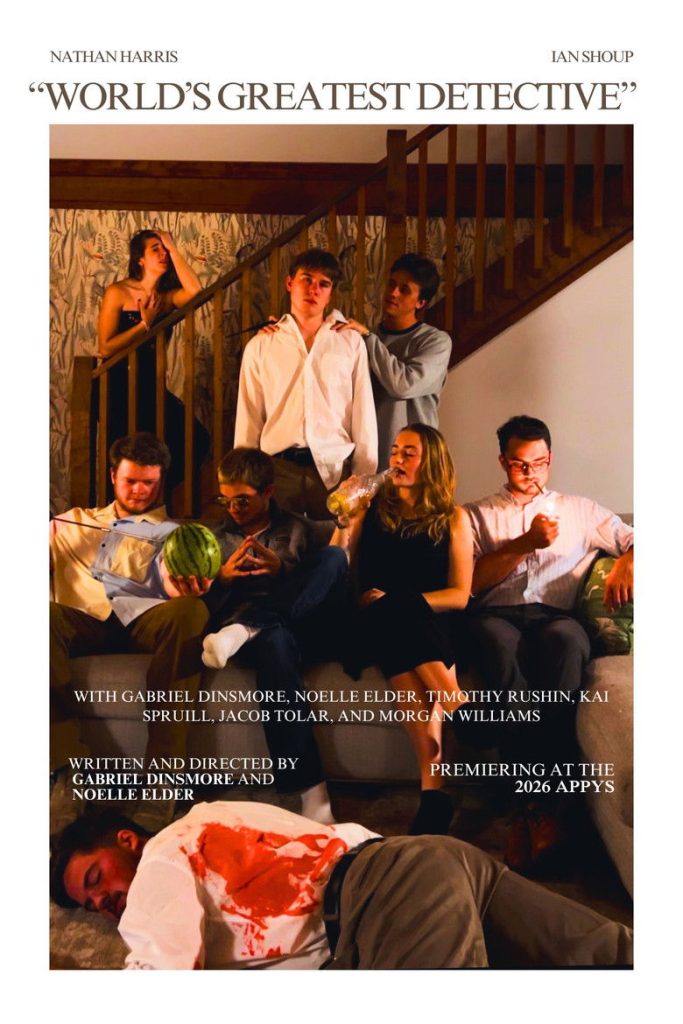
“World’s Greatest Detective” (2026)

Released: 2026-01-30 Recommended age: 8+ No IMDb rating yet
“World’s Greatest Detective”

Movie details

  • Genres: Mystery, Comedy
  • Director: Noelle Elder, Gabriel Dinsmore
  • Main cast: Gabriel Dinsmore, Kai Spruill, Tim Rushin, Noelle Elder, Jacob Tolar
  • Original language: en
  • Premiere: 2026-01-30

Story overview

In this 2026 mystery-comedy 'World's Greatest Detective,' young detective Eric Larsen tackles his most challenging case: investigating the murder of lawn chair mogul Reginald Benedict Chesterton III. Directed by Noelle Elder and Gabriel Dinsmore, and starring Gabriel Dinsmore, Kai Spruill, Tim Rushin, Noelle Elder, and Jacob Tolar, the film blends lighthearted humor with a playful detective storyline, suitable for family viewing with its 8-minute runtime.

Parent Guide

A family-friendly mystery-comedy with no concerning content, ideal for children aged 8 and up due to its simple plot and humor. The short runtime makes it easily digestible for young viewers.

Content breakdown

Violence & peril
Mild

Includes non-graphic references to a murder (off-screen) with no violence depicted; the peril is minimal and handled in a lighthearted, comedic way.

Scary / disturbing
None

No scary or disturbing elements; the mystery theme is presented playfully without suspense or fear-inducing scenes.

Language
None

No offensive or inappropriate language; dialogue is clean and suitable for all ages.

Sexual content & nudity
None

No sexual content or nudity; the focus is solely on the detective storyline and humor.

Substance use
None

No depiction or reference to substance use; the content is entirely family-oriented.

Emotional intensity
Mild

Low emotional intensity; the tone is consistently light and humorous, with no stressful or sad moments.

Parent tips

This short film is a gentle introduction to mystery themes for children, focusing on problem-solving and humor rather than intense suspense. With no explicit content, it's safe for most ages, but younger viewers might need help understanding the detective plot. Watch together to discuss how Eric solves the case and the comedic elements.

Parent chat guide

After watching, talk to your child about how Eric uses clues and logic to solve the mystery. Ask what they found funny or surprising, and discuss why it's important to think carefully like a detective. For older kids, you can explore themes of perseverance and teamwork in investigations.

Parent follow-up questions

  • What was your favorite part of the movie?
  • Can you pretend to be a detective like Eric?
  • Did you see anything funny in the story?
  • How did Eric figure out the mystery?
  • What clues did he use?
  • Why do you think the movie is called a comedy?
  • What makes a good detective in this film?
  • How does the humor add to the mystery?
  • Would you want to solve a case like this?
  • How does the film balance mystery and comedy genres?
  • What does it say about problem-solving in everyday life?
  • Is the short format effective for storytelling here?
⚠️ Deep Film Analysis (Contains Spoilers) · Click to Expand
A detective story where the real mystery is why anyone would trust this man with a magnifying glass.

🎭 Story Kernel

The film's core theme explores the dangerous intersection of ego and truth-seeking in the digital age. It's not really about solving crimes—it's about the protagonist's desperate need to be seen as brilliant, which ultimately corrupts the very justice he claims to pursue. The characters are driven by a hunger for validation in a world that rewards performative intelligence over actual wisdom. The detective's obsession with proving his superiority blinds him to the human cost of his investigations, revealing that the greatest threat to truth isn't deception, but narcissism disguised as intellect.

🎬 Visual Aesthetics

The cinematography employs a deliberately claustrophobic palette of muted grays and sickly yellows, mirroring the protagonist's narrowing worldview. Shaky handheld shots during 'deductions' create artificial tension, while static wide frames expose the emptiness of his supposed genius. The action sequences are notably clumsy—chases involve more tripping over clues than actual pursuit, visually undermining the detective's competence. Recurring visual motifs include reflective surfaces (windows, screens) where the detective gazes at his own distorted image rather than observing the world beyond.

🔍 Details & Easter Eggs

1
The detective's 'brilliant breakthrough' in Act 2 uses information the audience actually saw him overhear earlier—the film shows us he's cheating while presenting it as genius.
2
Every time the detective claims to notice a 'tell,' the suspect is actually reacting to something happening off-screen that the detective completely misses.
3
The final confrontation takes place in a hall of mirrors where the villain literally shows the detective multiple reflections of his own failures before the actual reveal.

💡 Behind the Scenes

The lead actor reportedly spent weeks shadowing real private investigators but insisted on developing his own 'more cinematic' deduction style against the director's wishes. Several key scenes were shot in an actual abandoned police precinct that the production designer found had perfect 'grime authenticity.' The film's notorious third-act rewrite happened after test audiences found the original ending 'too competent'—they reshot to emphasize the detective's fundamental inadequacy.

Where to watch

Streaming availability has not been announced yet.

SkyMe App
SkyMe Guide Download on the App Store
VIEW