
Worth (2021)
Story overview
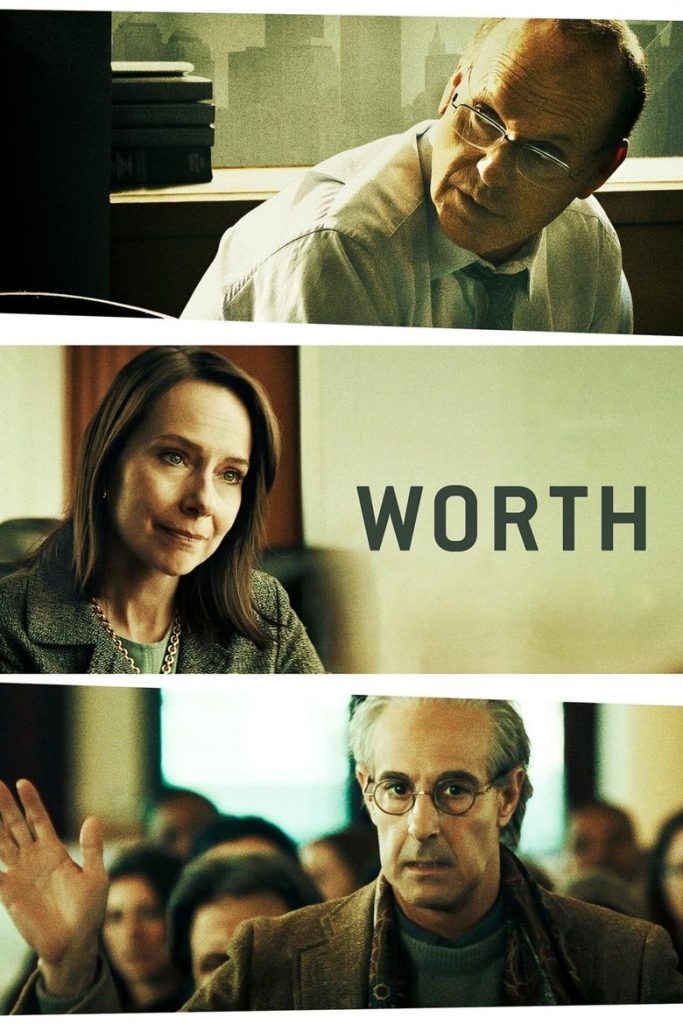
Worth is a 2021 historical drama based on true events following the September 11th attacks. It follows Kenneth Feinberg, a lawyer appointed to oversee the government's victim compensation fund. The film explores complex themes of bureaucracy, grief, justice, and the difficult task of assigning monetary value to human life in the aftermath of tragedy. The story focuses on legal and ethical debates rather than depicting the attacks themselves.
Parent Guide
A thoughtful drama about the aftermath of 9/11 focusing on legal and ethical questions rather than violent events. Suitable for mature middle schoolers and older who can handle discussions of grief and loss.
Content breakdown
No physical violence shown. Brief references to the 9/11 attacks and resulting deaths, but no graphic depictions. Some tense discussions about tragic events.
Emotionally intense discussions about death, loss, and grief. References to the 9/11 attacks may be disturbing for younger or sensitive viewers. The film deals with heavy themes of mortality and tragedy.
Occasional mild profanity (words like 'hell' or 'damn'). No strong or frequent swearing.
No sexual content or nudity.
No depiction of substance use.
High emotional content dealing with grief, loss, and ethical dilemmas. Characters express strong emotions including anger, frustration, and sadness. The subject matter is inherently emotional given its connection to 9/11.
Parent tips
This film deals with mature themes related to 9/11 and grief, making it more suitable for older children and teens. Consider your child's emotional maturity and knowledge of historical events before viewing. The film contains emotional discussions about loss and death, but no graphic violence. It could serve as an educational tool about historical events and ethical decision-making for mature middle schoolers and high school students.
Parent chat guide
Parent follow-up questions
—
—
- What did you learn about 9/11 from this movie?
- Why do you think it was hard for the lawyer to decide how much money families should get?
- How did the movie show people helping each other?
- How does the film explore the tension between legal procedures and human emotions?
- What ethical dilemmas did Kenneth Feinberg face, and how would you have handled them?
- How does the film portray the long-term impact of national tragedies on individuals and systems?
- What did you think about the film's approach to discussing grief and compensation?
🎭 Story Kernel
At its core, 'Worth' explores the collision between cold legal formulas and raw human grief. The film follows attorney Kenneth Feinberg's journey from detached bureaucrat to someone who recognizes that human suffering defies mathematical compensation. His initial approach—applying economic formulas to calculate lives lost on 9/11—gradually unravels as he encounters families whose pain can't be reduced to spreadsheets. The real conflict isn't between victims and government, but between systems designed for efficiency and the messy reality of human emotion. The film asks: Can we ever truly assign monetary value to a life, and what happens when we try?
🎬 Visual Aesthetics
The cinematography employs a muted, desaturated palette that mirrors the bureaucratic world Feinberg inhabits—government offices feel sterile with harsh fluorescent lighting, while family homes carry warmer, more natural tones. Camera movements are deliberate and restrained, often using static shots during legal discussions to emphasize the rigid structures at play. Visual contrasts emerge between the orderly grid of Feinberg's spreadsheets and the chaotic emotional landscapes of grieving families. The film's most powerful visual moments occur in silence—lingering shots on faces that convey what words cannot.
🔍 Details & Easter Eggs
💡 Behind the Scenes
Michael Keaton prepared for his role as Kenneth Feinberg by studying hours of actual footage and meeting with the real Feinberg, adopting his specific Boston accent and mannerisms. The production filmed in actual government buildings in New York to maintain authenticity. Director Sara Colangelo intentionally cast several non-professional actors who were personally affected by 9/11 in smaller roles to bring genuine emotional weight to the film's community scenes.
Where to watch
Choose region:
- Netflix
- Netflix Standard with Ads
Trailer
Trailer playback is unavailable in your region.